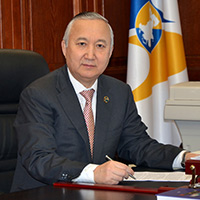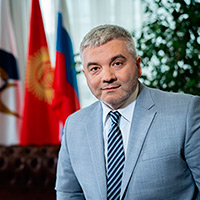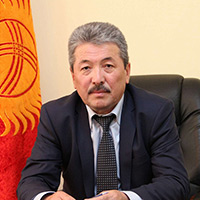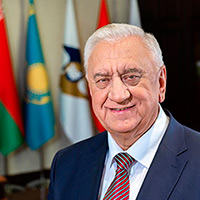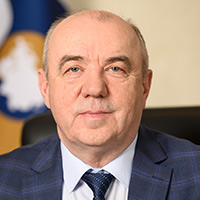


PRIME MINISTER
OF THE REPUBLIC
of Armenia
—
Nikol Pashinyan

PRESIDENT
of the Republic
of Belarus
—
Alexander Lukashenko

President
of the Republic
of Kazakhstan
—
Kassym-Jomart Tokayev

President
of the Kyrgyz
Republic
—
Sadyr Zhaparov

President
of the Russian
Federation
—
Vladimir Putin
of Armenia
OF BELARUS
of Kazakhstan
Republic
Federation
of Armenia

Capital — Yerevan
Territory — 29,7 thd sq. km2
Population — 3.0 million people
PRIME MINISTER
OF THE REPUBLIC of Armenia
Nikol Pashinyan
PRIME MINISTER OF THE REPUBLIC Armenia
Nikol PashinyanWe are committed to active interaction with the EEU partners in the interests of the practical achievement of the freedom of movement of goods, services, labor and capital, as well as the introduction of preferential economic cooperation regimes governed by the law of the Union.

Key Industries
Economic Indicators
In 2018, gross domestic product at current prices was 12.4 bln US dollars. The volume index of gross domestic product (at constant prices) in 2018 over 2017 was 105.2%.
The industrial output at current prices in 2018 was 4.0 bln US dollars. The industrial production index (at constant prices) in 2018 over 2017 was 104.2%.
The agricultural output at current prices in 2018 was 1.8 bln US dollars. The volume index of gross domestic product (at constant prices) in 2018 over 2017 was 92.4%.
Key Industries
Extraction and processing of construction raw materials, nonferrous industry, wine and cognac production. There are enterprises manufacturing metal-cutting machines, molding equipment, precision instruments, synthetic rubber, tires, plastics, chemical fibers, mineral fertilizers, electric motors, tools, microelectronics, jewelry, silk fabrics, knitted goods, legwears.
CUSTOMS INFRASTRUCTURE AT THE EAEU EXTERNAL BORDERS
Length of the customs border is 1,254.00 km (1.9%).
Comprises 4 automobile, 1 railway, 2 air border-crossing points.
Priorities of National Economy
Food Industry
Agriculture is an important sector of Armenian economy, which contributed 18 percent to the country's GDP in 2006 — 2010. The food sector in Armenia grows rapidly and has the largest export potential due to local organic agricultural products.
Mining Industry
Armenia is rich in some mineral resources. There are over 480 proven mineral deposits in the country. The mining industry makes important contributions to Armenia's economy and has become one of the most rapidly-growing export sectors in recent years with ores and metals constituting over a half of the country's export.
Energy
Energy is one of the most fully functional and profitable sectors of Armenia's economy. Armenia meets its domestic energy demands. Armenia has created an independent regulatory agency for energy, natural gas and heat supply systems. The country shows considerable progress in improvement of licensing, cross subsidies and profitable pricing, and tariff structure. With no industrial fuel resources, Armenia believes it is very important to develop its own renewable energy sources, e.g. hydro energy, wind and solar energy.
Information Technologies and Telecommunications
IT/telecommunications is one of the most productive sectors of Armenian economy. The government has declared IT a priority sector and supports it through various organizations, e.g. IT Development Support Council chaired by Armenian Prime-Minister, Enterprise Incubator Foundation. The sector of IT and telecommunications of Armenia has managed to attract global brands, such as Synopsys (carries out a significant part of its activity in Armenia), Microsoft, National Instruments, Mentor Graphics, Ericsson and Orange.
Chemical and Pharmaceutical Sectors
Abounding traditions of high-quality chemicals production made it possible for the pharmaceutical sector to become one of the most dynamically developing sectors in Armenia in the last decade. 57 percent of the products are exported, and the average annual increase has been 24 percent (since 2003). Such growth can be accounted for by several important factors: highly qualified and educated personnel, business enthusiasm and considerable local and direct foreign investments.
Tourism
Tourism is one of the leading and dynamically developing sectors of Armenia's economy. Having rich historical and cultural resources, Armenia can offer competitive tourist products and highly qualified services. In recent years, the average annual increment of tourists visiting Armenia has been 25 percent. In 2011, 800,000 tourists visited the country.
OF BELARUS

Capital — Minsk
TERRITORY — 207.6 THOUSAND SQ. KM2
POPULATION — 9.5 MILLION PEOPLE
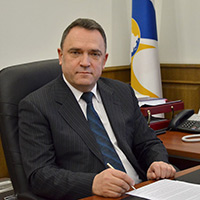
PRESIDENT
of the Republic of Belarus
Alexander Lukashenko
PRESIDENT of the Republic of Belarus
Alexander LukashenkoFor Belarus, a deep productive integration with the closest neighbors has been, is and will always be a natural path of the development. Two referendums—with an absolute majority—gave the authorities a clear mandate for integration.
The best practices of integration within the Union State allow for their reasonable and confident application in a wider multilateral format. It is important for the Union State, Customs Union and Single Economic Space to enrich and complement one another.
Today we are coming to the implementation of the decisions conventionally called momentous. Our determination to enhance integration is not accidental. It's a manifest coming from life.

Key Industries
Economic Indicators
In 2018, gross domestic product at current prices was 59.6 bln US dollars. The volume index of gross domestic product (at constant prices) in 2018 over 2017 was 103.0%.
The industrial output at current prices in 2018 was 54.1 bln US dollars. The industrial production index (at constant prices) in 2018 over 2017 was 105.7%.
The agricultural output at current prices in 2018 was 9.3 bln US dollars. The volume index of gross domestic product (at constant prices) in 2018 over 2017 was 96.6%.
The oil production, including gas condensate, in 2018 amounted to 1.7 mln tons or 176.1 kg per capita.
The natural gas production in 2018 amounted to 0.2 bln m3 or 22.3 m3 per capita.
The exports of the Republic of Belarus in 2018 amounted to 33.9 bln US dollars (in 2017, 29.2 bln US dollars).
The imports of the Republic of Belarus in 2018 amounted to 38.4 bln US dollars (in 2017, 34.2 bln US dollars).
Key Industries
Metallurgy, mechanical engineering, metal working, chemical and petrochemical industries, light and food industries.
Priorities of National Economy
Alternative Energy
To develop all the trends in alternative energy, the Republic of Belarus has a considerable potential in nature, climate and resources. The technical potential for the development of renewable energy sources (hereinafter—RES) in Belarus is estimated to be 80 million tons of coal equivalent, which exceeds the total energy consumption of the country.
Electronics and Home Appliances
Launching home appliances and electronics production in Belarus provides an opportunity to have an unfettered access to the rapidly growing market of all three of the SES Member-States (Russia, Belarus and Kazakhstan) with estimated volume in 2012 of around $33 billion ($41.7 billion including computers, office equipment and cell phones). The annual average growth rate for 2009-2012 was 11-12 percent.
Biotechnologies and Pharmaceuticals
Launching pharmaceuticals production in Belarus provides a duty-free access to the large and dynamically growing market of all three of the SES Member-States (Russia, Belarus and Kazakhstan). In 2013, the aggregate volume of the SES pharmaceutical market was ca. $35.2 billion in wholesale prices (over 80 percent of the total pharmaceutical market of the CIS countries). Launching pharmaceuticals production in Belarus provides a duty-free access to the large and dynamically growing market of all three of the SES Member-States (Russia, Belarus and Kazakhstan). In 2013, the aggregate volume of the SES pharmaceutical market was ca. $35.2 billion in wholesale prices (over 80 percent of the total pharmaceutical market of the CIS countries).
of Kazakhstan

Capital — Astana
Territory — 2 724,9 thd sq. km2
Population — 17,4 million people
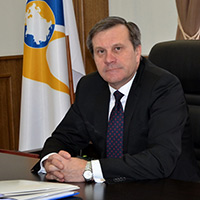
President
of the Republic of Kazakhstan
Kassym-Jomart Tokayev
President of the Republic of Kazakhstan
Kassym-Jomart Tokayev"For the first time in history, the Customs Union of Kazakhstan, Russia and Belarus brings our nations together on the basis of mutual respect, preservation of national identity and awareness of our common future's continuity.
A consistent transformation of the Customs Union into the Single Economic Space, and later on — into the Eurasian Economic Union will become a great impetus for our nations' prosperity. It will take our countries to leading positions in the world.
We are all witnessing the birth of a new unique Eurasian community of nations that has both extensive experience of the common past and an indivisible joint future."

Key Industries
Economic Indicators
In 2018, gross domestic product at current prices was 179.3 bln US dollars. The volume index of gross domestic product (at constant prices) in 2018 over 2017 was 104.1%.
The industrial output at current prices in 2018 was 79.0 bln US dollars. The industrial production index (at constant prices) in 2018 over 2017 was 104.4%.
The agricultural output at current prices in 2018 was 13.0 bln US dollars. The volume index of gross domestic product (at constant prices) in 2018 over 2017 was 103.4%.
The oil production, including gas condensate, in 2018 amounted to 90.4 mln tons or 4,944 kg per capita.
The natural gas production in 2018 amounted to 55.5 bln m3 or 3,034.2 m3 per capita.
Key Industries
Ferrous and non-ferrous metallurgy, chemical industry, mechanical engineering, light and food industry, as well as petroleum refining and production of construction materials.
Priorities of National Economy
Petroleum Refining and Oil-and-Gas Sector Infrastructure
Kazakhstan is ranked 11th in the world in oil reserves and 17th in gas reserves. In 2012 the Republic's extraction of oil and gas condensate made up around 79 million tons, gas extraction of 40 billion cubic meters. Average daily extraction of oil and gas condensate is over 200 thousand tons.
Ore Mining and Smelting
30 percent of the global reserves of chromium ore, 25 percent of manganese ores and 10 percent of iron ores are concentrated in Kazakhstan. Copper, lead and zinc reserves make up 10 and 13 percent of the global reserves, respectively. Kazakhstan is ranked 3rd in the world as a producer of titanium, 7th — of zinc, 8th — of lead, 13th — of iron ore, 15th — of copper, and 35th — of lead.
Chemical Industry
From 2008 to 2013, chemical industry production in Kazakhstan grew by 74.3 percent and made up Tenge 184.9 billion. In 2013, the chemical industry's specific weight in the overall industrial production was 1 percent. In 2013, the overall production of the chemical industry was $1,232 million.
Nuclear Industry
Ca. 19 percent of global explored reserves are concentrated in Kazakhstan sub-soils (According to IAEA). The country's total reserves are estimated at 802 tons of uranium.
Mechanical Engineering
Kazakh mechanical engineering industry's priority is to meet the demand of the domestic market to the fullest extent and expand export by raising manufacturing of products with high added value.
Pharmaceutical Industry
Kazakhstan's priority is to create environment for the import substitution of pharmaceutical and medical products based on modern technologies complying with international GMP standards. In the first six months of 2013, Kazakhstan exported pharmaceutical products for the total of $12.8 million, whereas the import for this period was $725.5 million.
Industry & Agriculture
The country's priority is the formation of food supplying belts around Astana and Almaty. Basic agriculture productions engaged in advanced processing of grain and meat will be primarily located in the northern regions.
Tourism
118 specially protected natural reservations operate in Kazakhstan, including 11 state national parks that allow eco-tourism. The Western Europe—Western China transport route that goes through five regions of Kazakhstan provides a unique opportunity to form a tourist cluster along it.
Information Technologies
As part of the program "Informational Kazakhstan-2020," the Government of the Republic has set four major goals to form an intellectual nation: efficient government management system; accessible information and communication infrastructure; information environment for social, economic and cultural development of the society; and developed information space.
Biotechnologies
Kazakhstan's own production of medical preparations makes up 11 percent (of which 1.1 percent is vaccines), veterinary preparations—78 percent, with the other preparations being imported.
Outer Space Exploration
Major goals of space sector in Kazakhstan is to create a full-fledged space exploration industry as a knowledge-intensive and high-tech sector of economy that would help accelerate the Republic's industry and innovation development, strengthen national security and defense, develop science and high technologies.
Alternative Energy
By 2015, wind turbines of total 125 MW are planned to be in operation that would yield 400 million kWh. By 2015, the Republic plans to commission new small hydroelectric power plants of total power over 100 MW that would yield 300 million kWh, by estimate. Taking into account the power the renewable energy sources produce at the moment, the production of power by RES is expected to be 1 billion kWh per year.
Republic

Capital — Bishkek
Territory — 199,9 thd km 2
Population — 5,9 million people
President
of the Kyrgyz Republic
—
Sadyr Zhaparov
President of the Kyrgyz Republic
Sadyr Zhaparov

Key Industries
Economic indicators
In 2018, gross domestic product at current prices was 8.1 bln US dollars. The volume index of gross domestic product (at constant prices) in 2018 over 2017 was 103.5%.
The industrial output at current prices in 2018 was 3.7 bln US dollars. The industrial production index (at constant prices) in 2018 over 2017 was 105.4%.
The agricultural output at current prices in 2018 was 3.0 bln US dollars. The volume index of gross domestic product (at constant prices) in 2018 over 2017 was 102.7%.
The oil production, including gas condensate, in 2018 amounted to 0.2 mln tons or 31.6 kg per capita.
The natural gas production in 2018 amounted to 0.03 bln m3 or 4.3 m3 per capita.
Main industries
Agriculture, hydropower, non-ferrous metallurgy, metal mining, machinery and instrument engineering, light and food industries.
Priorities of National Economy
TOURISM
There are over 67 thousand operating companies in the Kyrgyz Republic employing over 5.2% of workers of the country. Tourist services export is 678 million dollars. The sector accounts for 10% of the country's GDP. The annual amount of foreign visitors of the country is over 2.4 million people.
MINING INDUSTRY
The Kyrgyz Republic is situated on the one of the largest mineral deposits in Asia. The country is rich in mineral resources, it is well-known by its gold resources and rare metals deposits.
LIGHT INDUSTRY
Based on the simplified tax system and using cheap raw materials, light industry has been actively developing in the recent years. Thus, the growth rate of the production volume amounted to 59% over the last 5 years. In money equivalent, production of goods is USD 375 million per annum. 90,000 - 150,000 people are employed in the sector. The average monthly salary is USD 170. The industry is primarily focused on exports, 90% of products are supplied to the markets of Russia, Kazakhstan and Europe. Exports of clothing take the 2nd place in terms of volume after gold. 35,000 companies work in this sector. The sector uses the simplified tax system based on patent, which gave great impetus to the rapid development of the industry.
AGROINDUSTRIAL COMPLEX
Agroindustrial complex is one of the most high-priority and high-profit sectors of the Kyrgyz Republic. The sector's contribution to the country's economy is 17.5% of GDP. 30% of labour resource of the country are occupied in the industry. Over 357 thousand agricultural entities were registered in 2012. The annual gross output reaches USD 3.5 billion. All agricultural products are exempted from 12% VAT (Value Added Tax) that gives the industry competitive benefits in international markets.
TRANSPORTATION
Transportation is also an actively developing sector of the economy of the Kyrgyz Republic. Freight sector revenues in 2012 were USD 163 million. In 2012, the cargo traffic volume reached 39.4 million tonnes. The most widely-spread type of cargo transportation is motor freight transportation which amounted to 38 million tonnes in 2012.
CONSTRUCTION
Construction sector of the Kyrgyz Republic economy has a high potential. The scope of construction is growing every year in the Republic. Over 700 companies operate in this sector. The contribution to the country's GDP is 5.7%. In 2012, the industry growth reached 17%. According to official forecasts, the growth of the industry will reach 18% in the next 3 years.
ENERGY INDUSTRY
Energy sector is a strategic sector for the Kyrgyz Republic. Hydroelectric potential enables providing electric power not only in the entire country, but in the region's states. Hydraulic power engineering accounts for 53% of the whole volume of energy resources. This sector accounts for 2% of GDP and 16% of industrial production of the country. The sector ensures 10% of the Republican budget revenues/ Hydroelectric potential of the country is 142.5 bn kWh. However, the potential of the country is exploited only for 8 - 9.5%.
Federation

Capital — Moscow
Territory — 17,1 mln sq. km 2
Population — 146,3 million people
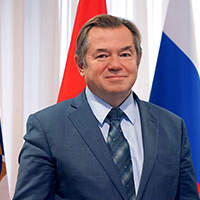
President
of the Russian Federation
Vladimir Putin
President of the Russian Federation
Vladimir Putin"Our ambitious goal is to come to a Eurasian Union. We propose a model of a powerful supranational association capable of becoming one of the poles in the modern world.
Natural resources, capitals, strong human potential all added up will help the Eurasian Union be competitive in the industrial technological race, in the competition for investors, for creation of new jobs and advanced productions. And along with other key players and regional structures—ensure stability of the global development.
Only united will our countries be able to join the leaders of global growth and civilized progress, achieve success and prosperity."

Key Industries
Economic Indicators
In 2018, gross domestic product at current prices was 1,661.0 bln US dollars. The volume index of gross domestic product (at constant prices) in 2018 over 2017 was 102.3%.
The industrial output at current prices in 2018 was 1,115.4 bln US dollars. The industrial production index (at constant prices) in 2018 over 2017 was 102.9%.
The agricultural output at current prices in 2018 was 81.9 bln US dollars. The volume index of gross domestic product (at constant prices) in 2018 over 2017 was 99.8%.
The oil production, including gas condensate, in 2018 amounted to 555.5 mln tons or 3,783.4 kg per capita.
The natural gas production in 2018 amounted to 726.0 bln m3 or 4,944.7 m3 per capita.
Key Industries
Extraction of petroleum and natural gas, processing of gemstones and metals, aircraft manufacture, space-rocket production, nuclear industry, manufacture of weapons and military equipment, electric engineering, paper-pulp industry, automotive industry, transport, road and agricultural mechanical engineering, light and food industry.
Priorities of National Economy
Energy Efficiency
The key target is to decrease by 40 percent the share of energy resources in the Russian GDP at the expense of saving energy, raising energy efficiency and bridging gaps in the regulatory legal base by 2020.
Space Technologies and Telecommunications
The key goal is to raise the efficiency and quality of information services provided in the country and develop an up-to-date information infrastructure in all sectors of the national economy.
Medical Technologies and Pharmaceuticals
The key goal is to produce most of medicines and medical devices in Russia, develop and produce innovative pharmaceuticals, as well as get access for Russian manufacturers to new markets.
Information Technologies and Software
To raise efficiency and quality of information services is a priority for Russia's national economy, as well as to develop a modern social and industrial information infrastructure.
Nuclear Energy
The key goal is to preserve the leadership of the Russian Federation in the global nuclear market, create environment for a guaranteed long-term supply of cheap energy, significantly reduce uranium consumption, and mitigate the risk of negative environmental effects.
THE SUPREME EURASIAN ECONOMIC COUNCIL
Read moreTHE EURASIAN INTERGOVERNMENTAL COUNCIL
Read moreEurasian Economic Commission
Read moreThe Court of the Eurasian Economic Union
Read moreThe Supreme Eurasian Economic Council is the supreme body of the Union, which includes the Heads of the EAEU Member States.
The Intergovernmental Council is a Union's body consisting of the Heads of the Member-States Governments.
Eurasian Economic Commission is a permanent supranational regulatory body of the Union, with its members appointed by the Council of the Commission and the Board of the Commission. The core tasks of the Commission are fostering the conditions to support the operation and development of the Union, and drafting proposals in the field of economic integration within the Union.
The Court of the Eurasian Economic Union is the court of justice of the Eurasian Economic Union, which ensures the uniform application of the EAEU Treaty and other Union treaties by the Union Member-States and bodies.
THE SUPREME EURASIAN ECONOMIC COUNCIL
President
of the Republic
of Kazakhstan,
CHAIRMAN
Kassym-Jomart Tokayev
Kazakhstan
THE EURASIAN INTERGOVERNMENTAL COUNCIL


PRIME MINISTER
OF THE REPUBLIC
OF KAZAKHSTAN,
CHAIRMAN
Olzhas Bektenov
Kazakhstan

Chairman of the Cabinet of Ministers — Head of the Presidential Executive Office
Adylbek Kasymaliev
Republic

Chairman of the Government
of the Russian Federation
Mikhail Mishustin
Federation
Eurasian Economic Commission Visit Commission Website
The Council of the Eurasian Economic Commission

Deputy Prime Minister of the Republic of Armenia
Mher Grigoryan

Deputy Prime Minister of the Republic of Belarus
Natalia Petkevich

Deputy Prime Minister of the Republic of Kazakhstan, Chairman
Serik Zhumangarin

First Deputy Chairman of the Cabinet of Ministers
Daniyar Amangeldiev

Deputy Chairman of the Government of the Russian Federation
Alexei Overchuk

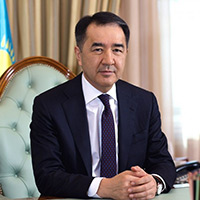
Chairman of the Board
of the Eurasian
Economic Commission
Bakytzhan Sagintayev
The Board of the
Eurasian Economic
Commission
|
|
|
|


|
|
|
|


|
|
|
|


The Court of the Eurasian Economic Union
—
Alexander Fedortsov
President
—
Zholymbet Baishev
Vice-President
Judge of the Court of the Eurasian Economic Union |
Judge of the Court of the Eurasian Economic Union |
Judge of the Court of the Eurasian Economic Union |
Judge of the Court of the Eurasian Economic Union |
Judge of the Court of the Eurasian Economic Union |
Judge of the Court of the Eurasian Economic Union |

President of Kazakhstan N. Nazarbayev at Lomonosov Moscow State University
Moscow, March 29, 1994


President of Kazakhstan N. Nazarbayev and the first President of Russia B. Yeltsin
Moscow, January 1995


Execution of the Treaty on Deepening Economic and Humanitarian Integration between the Republic of Belarus, the Republic of Kazakhstan, the Kyrgyz Republic and the Russian Federation
Moscow, March 29, 1996


President of Belarus A. Lukashenko, Prime-Minister of Kyrgyzstan K. Zhumaliev, President of Kazakhstan N. Nazarbayev, first President of Russia B. Yeltsin, and President of Tajikistan E. Rakhmon
Moscow, February 1999


The presidents of the Republic of Belarus, the Republic of Kazakhstan, the Kyrgyz Republic, the Russian Federation and the Republic of Tajikistan in Astana
October 10, 2000


President of Russia V. Putin, President of Kazakhstan N. Nazarbayev, President of Belarus A. Lukashenko, and President of Ukraine L. Kuchma
Yalta, September 2003


The presidents of the Member-States of the Eurasian integration processes at an informal summit of the Eurasian Economic Community in Sochi
August 16, 2006


At summit of the Eurasian Economic Community.
Dushanbe, October 2007


Heads of the Eurasian Economic Community Member-States and the Secretary-General of the Eurasian Economic Community.
Moscow, December 2010

Heads of States – Members of the Supreme Eurasian Economic Council, and Heads of States involved in Eurasian integration.
Moscow, December 2011


Heads of States – Members of the Supreme Eurasian Economic Council, and Heads of States involved in Eurasian integration.
Moscow, December 2011


The Presidents of the CU and SES Member-States signed the Treaty on the Eurasian Economic Union (EEU) at the session of the Supreme Eurasian Economic Council. The Treaty has become a landmark of the transition of the Eurasian economic project to a new, higher level of integration.
May 29, 2014


The EEC adopted key measures and decisions to combat the spread of COVID-19 coronavirus infection and the pandemic's consequences
The Republic of Uzbekistan and the Republic of Cuba were granted the status of Observer States at the EAEU.
The Heads of the EAEU States have approved the Strategic Directions for Developing the Eurasian Economic Integration until 2025.
The Heads of the EAEU States have agreed to launch negotiations on a Free Trade Agreement with Iran.
The President of Kazakhstan Nursultan Nazarbayev voiced the idea of the Eurasian Union of States for the first time at Lomonosov Moscow State University, during his first official visit to Russia on March 29, 1994.
In June 1994, a detailed integration project was submitted to the Heads of the States and then published in the press. For the first time, the integration alliance was called “the Eurasian Union” in an official document.
In 1995, the Republic of Belarus, the Republic of Kazakhstan and the Russian Federation signed the Treaty on the Customs Union, aimed to eliminate any barriers hindering free economic cooperation between the Parties’ economic agents, ensure free trade and fair competition, and eventually guarantee sustainable economic development of the Parties.
The Treaty signed by the three States in 1995 created the integration nucleus that now drives the integration in the Eurasian region.
The Presidents of the Republic of Belarus, the Republic of Kazakhstan, the Kyrgyz Republic and the Russian Federation signed the Treaty on Deepening Economic and Humanitarian Integration on March 29, 1996 in Moscow. The Republic of Tajikistan joined the Treaty in 1998.
Designed as the ultimate form of equal and mutually beneficial cooperation, the Eurasian Union is in fact a model of civilized interaction between independent states in the former Soviet space, which maintain their sovereignty, territorial integrity and inviolability of borders. These principles start materializing gradually.
On May 23, 2000, the meeting of the Interstate Council, held in Minsk, decided to draft, by September 2000, a Treaty on the creation of an integration alliance between the Republic of Belarus, the Republic of Kazakhstan, the Kyrgyz Republic, the Russian Federation, and the Republic of Tajikistan
October 10, 2000, the presidents of the Republic of Belarus, the Republic of Kazakhstan, the Kyrgyz Republic, the Russian Federation and the Republic of Tajikistan established the Eurasian Economic Community in Astana to promote efficiently the formation of the Customs Union and Single Economic Space.
In January 2010, the Customs Union of the Republic of Belarus, the Republic of Kazakhstan and the Russian Federation was launched: the Common Customs Tariff was implemented, customs formalities and customs control at the internal borders were cancelled, and free movement of goods within the three states was ensured.
In December 2010, 17 primary international treaties were adopted, providing the basis for the functioning of the Single Economic Space, and also the Declaration on Establishment of the Single Economic Space of the Republic of Belarus, the Republic of Kazakhstan and the Russian Federation was signed.
During the meeting of the Heads of the Customs Union Member-States in November 2011, the Presidents of the integrating three States signed the Declaration on Eurasian Economic Integration, declaring successful operation of the Customs Union and announcing the transition to the next stage of integration, the Single Economic Space. The Heads of the Customs Union Member-States also signed the Treaty on the Eurasian Economic Commission.
In October 2011, a decision was taken to start negotiations on the accession of the Kyrgyz Republic to the Customs Union.
The Supreme Eurasian Economic Council at the level of the Heads of States took the Decision on the Enactment of the Treaties Establishing the Single Economic Space of the Republic of Belarus, the Republic of Kazakhstan and the Russian Federation on December, 2011 in Moscow, whereunder the treaties establishing the Single Economic Space would enter into force on January 1, 2012.
In January 2012, the treaties entered into force, which provide the legal framework for the Single Economic Space of the Republic of Belarus, the Republic of Kazakhstan and the Russian Federation and also ensure free movement not only of goods, but also of services, capital and labour. Over 50 documents are being drafted to implement the “four freedoms” completely.
The Eurasian Economic Commission, headquartered in Moscow, started its work in February.
May 29, 2014, the Presidents of the CU and SES Member-States signed the Treaty on the Eurasian Economic Union (EAEU) at the session of the Supreme Eurasian Economic Council. The Treaty has become a landmark of the transition of the Eurasian economic project to a new, higher level of integration.
October 10, 2014, the Agreement on Accession of the Republic of Armenia to the EAEU was signed in Minsk, during the session of the Supreme Eurasian Economic Council.
December 23, 2014, Moscow, the Presidents of the Republic of Belarus, the Republic of Kazakhstan and the Russian Federation, on the one part, and the President of the Kyrgyz Republic, on the other part, signed the Agreement on Accession of the Kyrgyz Republic to the EAEU.
Enactment of the Treaty on the Eurasian Economic Union
Accession of the Republic of Armenia to the EAEU
Accession of the Kyrgyz Republic to the EAEU
Enactment of the Agreement on Free Trade Area between the EAEU and Vietnam
Declaration of the EAEU countries’ Presidents “On Digital Agenda of the Eurasian Economic Union”
White Paper of barriers, exceptions and restrictions
Signing and ratification of the Treaty on the EAEU Customs Code
Enactment of the Treaty on the EAEU Customs Code
Granting the EAEU observer country status to the Republic of Moldova
Signing of the Agreement on Trade and Economic Cooperation between the EAEU and the PRC
Signing of the Interim Agreement leading to the creation of a free trade area between the EAEU and Iran
5 years of the EAEU Treaty
Signing of the Agreement on Pension Benefits of Workers
Signing of Free Trade Agreement between the EAEU and Singapore
Signing of Free Trade Agreement between the EAEU and Serbia
Enactment of the Agreement on Trade and Economic Cooperation between the EAEU and the PRC
Enactment of the Interim Agreement leading to the creation of a free trade area between the EAEU and Iran
The Agreement on Pension Provision for Workers of the EAEU Member States entered into force
The Agreement on the Use of Navigation Seals for Monitoring Traffic in the EAEU
The High-Level Working Group to develop proposals for converging positions of the EAEU Member States within the climate agenda assumed its duties
The Main Directions of Industrial Cooperation until 2025 were approved
A set of measures and EEC decisions aimed at improving the sustainability of the EAEU economies was adopted.
The Agreement on using navigation seals for monitoring traffic in the Eurasian Economic Union was signed.
The Agreement on the Incorporation of the Eurasian Reinsurance Company was signed.
Implementation of the Eurasian Agroexpress, a joint project of the EAEU countries for accelerated rail and multimodal transportation, received support.
A new format for financing industrial cooperation projects was approved.
A decision to start negotiations with the United Arab Emirates on concluding a free trade agreement was taken.
A decision to start negotiations on a free trade agreement between the EAEU and Indonesia was taken.
The Agreement on mutual recognition of bank guarantees for public procurement was signed.
Rules of Access to Services of Interstate Transmission of Electric Power (Capacity) within the Common Electric Power Market of the EAEU were approved.
The Agreement on the rules of release (issue), circulation and redemption of warehouse certificates for agricultural products within the EAEU was concluded.
The Agreement on Mutual Recognition of Higher Degree Certificates in the EAEU Member States was signed.
The Methodology for qualifying obstacles in the internal market of the Eurasian Economic Union and recognizing barriers and restrictions as eliminated was approved; it was based on the practice of using mediation procedures.
A free trade agreement was signed between the EAEU and the Republic of Iran.
The Eurasian Economic Path Declaration on further development of economic processes within the EAEU until 2030 and for the period until 2045 was signed.

Outcomes of EIC meeting on June 3-4, 2024
The Heads of Government of the Eurasian Economic Union considered 12 issues at a meeting of the Eurasian Intergovernmental Council on June 3-4 in Nesvizh (Republic of Belarus).
The Intergovernmental Council approved the annual report of the Eurasian Economic Commission on the state of competition in transboundary markets and measures taken to suppress violations of general competition rules therein for 2023. During the reporting period, the Commission continued to monitor compliance with the general competition rules in the EAEU transboundary markets within the procedures carried over from previous periods, as well as in terms of reviewing incoming applications and materials.
The Heads of Government of the EAEU countries were presented with a report on monitoring the regulatory impact assessment (RIA) of draft EEC decisions in 2023. The report contains information on finalizing the regulatory and legal framework required for implementing the actual impact assessment (AIA) of adopted EEC decisions, as well as for extending the AIA to draft international treaties within the Union.
The Members of the Intergovernmental Council approved the report for 2023 on creating and developing transport infrastructure in the territories of the EAEU Member States in the East-West and North-South directions, including as part of coupling with the Chinese Belt and Road Initiative. The preparation of this report on an annual basis is envisaged by the Strategy-2025.
According to Bakytzhan Sagintaev, Head of the EEC Board, the Islamic Republic of Iran has expressed interest in obtaining the Observer State status at the EAEU. The Eurasian Economic Commission received the relevant note on May 27. It will be considered in the determined procedure. This statement was made by the Chairman of the EEC Board within the press scrum following the meeting.
The Intergovernmental Council determined that the next EIC meeting will be held in late September – early October in Yerevan.
EEC reported on state of competition in transboundary markets
The Eurasian Intergovernmental Council approved the annual report of the Eurasian Economic Commission on the state of competition in transboundary markets and measures taken to suppress violations of general competition rules therein for 2023.
During the reporting period, the Commission continued to monitor compliance with the general competition rules in the EAEU transboundary markets within the procedures carried over from previous periods, as well as in terms of reviewing incoming applications and materials. Applications received in 2023 concern the construction, pharmaceutical, chemical and food sectors of the EAEU States' economies.
The report provides detailed information on all 15 applications and materials submitted to the Commission. The largest number of signs of violations of the Union's law concerned unfair competition – there were 10 such materials. There were signs of abuse of dominant position in four of them and signs of anticompetitive agreement in one of them.
In 2023, the Commission conducted 8 investigations, issued one caution, and 11 cases were pending. After considering the cases, 7 decisions were adopted by the Commission's Board.
Besides, the report reflects the results of considering notifications on introduction of state price regulation in the Union countries' commodity markets. It contains information on improving the EAEU law and the Member States' legislation in the field of competition and antitrust regulation. A separate block covered the activities of the Commission on Competition Advocacy and International Cooperation. The annual report on competition approved by the Intergovernmental Council will be posted on the Union's official website.
EAEU does not slow down pace of transport infrastructure development
At the meeting of the Intergovernmental Council held on June 4 in Nesvizh (Belarus), the Heads of Government of the Eurasian Economic Union approved the report for 2023 on creating and developing transport infrastructure in the territories of the EAEU Member States in the East-West and North-South directions, including as part of coupling with the Chinese Belt and Road Initiative. The preparation of this report on an annual basis is envisaged by the Strategy-2025.
The document notes that last year the EAEU countries conducted outreach efforts on developing sections of national transport infrastructure, creating logistics services, concluding international treaties and memorandums with partners on the transport corridors development.
“In 2023, the “five“ countries did not slow down the pace of transport infrastructure development and managed not only to overcome emerging difficulties, but also to implement a number of large-scale transport projects,” noted Arzybek Kozhoshev, Minister in charge of Energy and Infrastructure of the Eurasian Economic Commission.
As part of diversifying transport and logistics links, the North-South corridors and the Trans-Caspian International Transport Route have received a new impetus in development.
In 2023, by decision of the Intergovernmental Council, the list of priority integration infrastructure projects in the field of transport was supplemented with new projects from Kyrgyzstan and Kazakhstan. Now the list includes 11 large-scale projects on construction and reconstruction of roads and railways.
In order to fulfill and develop transit potential within the EAEU and coordinate transport infrastructure, the Comprehensive Plan for developing the Eurasian transport corridors was adopted.
The Commission is actively engaged in increasing international cooperation in the field of transport with China, UAE and Iran.
At the proposal of Armenia, the report includes the “Crossroads of the World” initiative, designed to create favorable conditions for developing trade and economic ties between all interested countries and to unlock the logistics potential of the South Caucasus region.
Assessment of impact on business environment to cover all stages of EAEU regulation
The Heads of Government of the Eurasian Economic Union countries were presented with a report on monitoring the regulatory impact assessment (RIA) of the Eurasian Economic Commission’s draft decisions in 2023.
“The vast majority (77%) of draft acts subject to the RIA process in 2023 envisaged amendments to the existing decisions of the Commission with the establishment of simplifications for entrepreneurs, with due regard to the practice of applying these decisions,” noted Bakhyt Sultanov, EEC Minister in charge of Economy and Financial Policy.
The report contains information on finalizing the regulatory and legal framework required for implementing the actual impact assessment (AIA) of the adopted EEC decisions, as well as for extending the AIA to draft international treaties within the EAEU.
These procedures started to apply in March 2024. Their implementation makes it possible to ensure comprehensive coverage by assessing the impact on the business environment of all stages of the regulation life cycle within the Union: from developing fundamental approaches to the regulation of business activities to analyzing specific practical consequences of applying the EAEU law by economic entities.
Expanding the mechanisms for assessing the impact on the business environment will also help increase the level of involvement of the EAEU countries' business communities in the processes of the Eurasian economic integration.
The RIA is a procedure for assessing the impact of the EEC draft decisions on the business environment; when performing the RIA procedure, opinions of the EAEU countries’ business community are taken into account.
The RIA procedure consists of two stages: current assessment, i.e. public discussion of the EEC's draft decision on the EAEU website for at least 30 calendar days and final assessment, i.e. preparation of the RIA statement by a specially created Working Group of the EEC.

EAEU approved single indicative rate of excise duties on tobacco products
On May 29, the decision of the Eurasian Economic Commission's Council approved the level of a single indicative rate of excise duties on tobacco products (filtered cigarettes) in the Eurasian Economic Union States for 2029.
The indicator is set at 45 euros per 1,000 pieces with an allowable range of deviation from it of actual excise rates by no more than 20% upward or downward. For comparison, the rate for 2024 was set at 35 euros per 1,000 pieces with a similar range of deviation.
The harmonized rates are stipulated by the Agreement on the principles of tax policy in the field of excise duties on tobacco products of the EAEU States and are implemented through establishing a five-year period for achieving the level of the single indicative excise duty rate (SIEDR) on tobacco products sold in the territories of the Eurasian “five” countries.
According to Bakhyt Sultanov, EEC Minister in charge of Economy and Financial Policy, the need to increase the SIEDR level in 2029 from 35 to 45 euros per 1,000 pieces is due to the risks of the shadow market growth and the volume of counterfeit products in connection with a significant increase in excise duties on tobacco products in a number of the Union countries and its “spillover” to the territories of the EAEU States with higher tax rates of excise duties.
“This indicator serves as a benchmark for public authorities planning excise duties on filtered cigarettes for a five-year period, as well as for tobacco product manufacturers planning their financial and economic activity. In the absence of significant fluctuations in the exchange rates of national currencies against the euro, all the EAEU States will reach the established SIEDR level in 2024", Bakhyt Sultanov commented on the news.

EAEU amended rules for marketing authorization and expert examination of medicines
At its meeting held on May 29, the Eurasian Economic Commission's Council amended the Rules for Marketing Authorization and Expert Examination of Medicines for Human Use.
The administrative part of the procedure for making amendments to the marketing authorization application of an authorized medicinal product has been updated with due regard to law enforcement. The list has been expanded and the types of amendments to the marketing authorization application that do not require expert work and are carried out in a notification procedure have been clarified.
Valentin Tataritsky, EEC Minister in charge of Technical Regulation, noted: “The introduction of the risk-based approach makes it possible to reduce the regulatory burden and expand the use of the notification procedure when making amendments to the marketing authorization application”.
The decision of the Commission's Council will make it possible to optimize the procedures performed by the authorized bodies (expert organizations) of the Eurasian Economic Union States when carrying out expert work and assessing the marketing authorization application for different types of amendments in respect of authorized medicines. The preparation of materials for marketing authorization application by pharmaceutical manufacturers is being optimized as well.
This simplified procedure for amending the marketing authorization application will apply to applications submitted from March 1, 2024 (i.e. the provisions of the Decision adopted by the Council apply to legal relations arising from March 1 this year).

The unified list of products subject to state registration has been supplemented with oral hygiene products and devices
On May 14, the Council of the Eurasian Economic Commission adopted amendments to Section II of the Unified List of Products (Goods) Subject to State Sanitary and Epidemiological Surveillance (Control) at the customs border and customs territory of the Eurasian Economic Union.
The document includes provisions for conformity assessment in the form of state registration of oral hygiene products and devices. The only exceptions are products that are subject to the technical regulations of the Eurasian Economic Union “On the safety of perfumery and cosmetic products”, since today not all oral hygiene products and devices undergo a conformity assessment procedure confirming their safety for human health before being put into circulation on the Union market.
The decision of the EEC Council will make it possible to minimize the release into circulation on the Union market of oral hygiene products and devices that have not passed the conformity assessment, and to eliminate the legal gap in conducting state sanitary and epidemiological surveillance (control).

The EEC Council amended the technical regulation "On Safety of Toys"
The Council of the Eurasian Economic Commission at a meeting held on May 14 amended the technical regulation of the Eurasian Economic Union "On Safety of Toys".
The need for amendments has been established through the practice of its application. The Technical Regulation has been supplemented with new terms (e.g. "scented toy", "stuffed toy", "rattle", "set for the development of taste skills (taste set)" and others) and requirements to new types of toys (e.g. board games for the development of sense of smell, taste sets and others).
"The toy industry doesn't stand still. In the market, the range of toys is constantly expanding, new types of toys are appearing. The changes establish requirements to such products, which will improve the safety of toys in general. Also, the instantiation of certain provisions, the need for which was identified during the application of the current version of the technical regulation, will help entrepreneurs to increase the efficiency of production while complying with the safety requirements to toys," said Valentin Tataritsky, EEC Minister for Technical Regulation.
The above amendments and changes to the technical regulation will come into effect in six months after the date of official publication of the Council's decision on amendments.

Results of the meeting of the EEC Council on May 14, 2024
The EEC Council amended the technical regulation "On Safety of Toys"

New version of the rules for determining the origin of goods from developing and the least developed countries approved
The Council of the Eurasian Economic Commission has decided to modernize the rules for determining the origin of goods from developing and the least developed countries - users of the unified system of tariff preferences of the Eurasian Economic Union.
The updated version contains a package of comprehensive amendments, which provide for improvement of the procedure for documentary confirmation of origin of goods, simplification of conditions for importers to obtain tariff preferences, optimization of provisions on administrative cooperation with beneficiary countries, as well as a number of other changes prepared in terms of the existing five-year law enforcement practice.
In particular, the possibility to confirm the origin of goods applying for tariff preferences by a copy of the document of origin instead of its original is fixed on a permanent basis. In addition, the requirement to purchase goods exclusively from persons registered in countries that are users of the unified system of tariff preferences of the EAEU has been abolished.
"The adopted decision is an effective measure to adapt the rules applied in the Union to modern trade conditions and minimize existing difficulties with confirmation to the customs authorities of the EAEU Member States of the preferential origin of the supplied goods," said EEC Trade Minister Andrey Slepnev.He added that these changes are also a continuation of the Union's consistent work on the implementation of support measures for the least developed countries, the need for which is regularly discussed on the platform of the World Trade Organization.
The Decision shall come into effect after 60 calendar days from the date of its official publication.
For reference
The rules for determining the origin of goods from developing and the least developed countries were approved by Decision of the Council of the Eurasian Economic Commission No. 60 dated June 14, 2018.
The lists of countries-users of the unified system of tariff preferences of the EAEU are established by the Decision of the Customs Union Commission No. 130 dated November 27, 2009.
The list of goods in respect of which tariff preferences are granted was approved by Decision of the Council of the Eurasian Economic Commission No. 8 dated January 13, 2017.

Discussion on implementing the Main Directions of the EAEU International Activities in 2023
The year 2023 became important in terms of developing various areas of international activity of the Eurasian Economic Union. This is stated in the report of the Eurasian Economic Commission presented at a meeting of the Supreme Eurasian Economic Council in Moscow on May 8.
The number of the Union's partners increased: memorandums of understanding were signed with the governments of Myanmar and Nicaragua, and a full-scale trade agreement was concluded with Iran. Negotiations were held with Egypt, the UAE and Indonesia. The joint study group concluded that it would be advisable to conclude an interim trade agreement with Mongolia.
Interaction with the Observer States of the Union – Uzbekistan and Cuba – developed consistently. It is focused not only on the exchange of experience, but also on strengthening trade and economic ties through the implementation of joint projects, converging certain legal regulations and establishing direct contacts between business circles.
The track of interaction between the Union and the CIS was further developed. The basic contours and goals of interaction between the Union and BRICS were laid down. Interaction with the SCO, ASEAN and other integration structures is deepening, including in terms of positioning the Union as one of the economic centers establishing the integration outline of the Greater Eurasian Partnership.
The Commission intensified its involvement in the activities by the working bodies of international organizations, forums and other events organized by them, took into account best international practices, and prepared proposals for their application in improving the law of the Union.
It is now an established practice to invite foreign leaders to meetings of the Supreme Eurasian Economic Council and the Eurasian Intergovernmental Council, place Union issues in the programs of international events held in the Member States, including through international organizations in which the Member States preside, as well as intensify dialogue with foreign business associations and expert communities. These efforts serve to strengthen the international image of the EAEU.
The analysis carried out in the report allows to see a comprehensive picture of the Union’s international activities. SEEC Members took note of the document.

SEEC: Strategy 2025 is being successfully implemented
At the May 8 meeting of the Supreme Eurasian Economic Council, Heads of State of the Eurasian Economic Union were presented with a report on implementing the Strategic Directions for Developing Eurasian Economic Integration until 2025 based on the 2023 results.
The document prepared by the Eurasian Economic Commission contains information on the results of the third year of implementing the Strategy 2025 and the corresponding action plan. It was noted that most of the activities planned for implementation in 2023 had been completed.
Successful implementation of the Strategy 2025 has a significant impact on the functioning of the EAEU, ensuring that integration processes are developed in key areas of cooperation.
Based on the results of last year, the most significant results are highlighted. They are related to ensuring the possibility of launching a mechanism for financing industrial cooperation, as well as a mechanism for tracking shipments using navigation seals, mutual recognition of academic degrees, bank guarantees for public (municipal) procurement, unifying the approaches of the EAEU countries to identify and confirm the origin of goods exported outside the customs territory of the Union, the emerging institution of authorized exporters in the EAEU, developing electronic commerce, etc.
This year, systematic work continues on about 60 activities of the Strategy 2025 with a fixed deadline for implementation in 2024.
For reference
Strategy 2025 was approved by Decision No. 12 of the Supreme Eurasian Economic Council dated December 11, 2020. The action plan for implementing the Strategy 2025 was approved by Disposition No. 4 of the Eurasian Economic Commission Council dated April 5, 2021.

EAEU and Mongolia begin official negotiations on duty-free trade terms
Following the meeting of the Supreme Eurasian Economic Council, held in Moscow on May 8, 2024, the leaders of the Eurasian Economic Union countries supported the proposal to formally initiate negotiations on concluding a temporary trade agreement with Mongolia.
“Mongolia is not just a neighbor, but also an important partner for our countries. Together with our colleagues from Ulaanbaatar, we have comprehensively studied the trade policy instruments that can be used to deepen mutually beneficial cooperation, as well as the effects of establishing a free trade regime,” Andrey Slepnev, Minister in charge of Trade of the Eurasian Economic Commission, commented on the decision.
He clarified that this work resulted in the conclusion that at the current stage it was advisable to opt for a temporary trade agreement, within the framework of which duties in mutual trade would be abolished or reduced on a limited range of goods. This proposal was supported by SEEC Members.
As previously reported, preparatory work on a temporary trade agreement between the EAEU and Mongolia has already begun and can be completed before the end of this year.
“In the first quarter, we held detailed consultations with the Mongolian party and already agreed on the framework of a future trade deal. Taking into account how the leaders of the EAEU countries and Mongolia support the ongoing work, there is every reason to believe that we will be able to report to SEEC Members that the agreement is prepared for signing in the shortest possible time,” added Andrey Slepnev.

EAEU adopted uniform Rules for pharmaceutical inspections of pharmacovigilance systems of medicine manufacturers
At its meeting held on April 12, the Eurasian Economic Commission's Council supplemented Decision No. 83 of the EEC Council dated November 3, 2016 with the Rules for pharmaceutical inspections for compliance with the requirements of the Good Pharmacovigilance Practice Rules of the Eurasian Economic Union.
Valentin Tataritsky, EEC Minister in charge of Technical Regulation, noted: "The amendments are aimed at preserving medicines with a proven positive benefit-risk profile in circulation in the Union's pharmaceutical market and excluding from circulation and production those medicines that pose a threat to public health and well-being of the population".
Nowadays, the authorized bodies of the Eurasian Economic Union States inspect the pharmacovigilance system of marketing authorization holders in accordance with the Member States' legislation. This creates the prerequisites for different approaches to pharmaceutical inspections of the pharmacovigilance system and possible non-recognition of the inspection results in some EAEU countries.
The document adopted by the EEC Council establishes unified approaches to the procedures for conducting inspections of pharmacovigilance systems and interaction between the Member States' authorized bodies. Repeated (duplicate) inspections of medicine manufacturers by each of the Member States' inspectorates are eliminated, which will make it possible to optimize inspection resources.
The Rules for pharmaceutical inspections of the pharmacovigilance system are harmonized with the current version of the European Rules and are based on the best practice and use of experience in assessing real issues of safety and efficacy of medicinal products circulating in the Union's pharmaceutical market.
Outcomes of EEC Council's meeting on April 12, 2024
The Rules for conducting bioequivalence studies of medicinal products were amended.
The EAEU expands the list of light industry goods subject to marking with identification means.
Entrepreneurs from the EAEU countries and Iran will continue cooperation within the Free Trade Agreement.Union's technical regulation on agricultural and forestry tractors and their trailers amended.

EAEU expands list of light industry goods subject to marking with identification means
The Eurasian Economic Commission's Council has considered a proposal submitted by the Russian Federation to expand the list of light industry goods subject to marking with identification means and has decided to amend existing regulatory legal acts of the Eurasian Economic Union.
The amendments concern only the types of products subject to marking approved by Decision No. 127 of the Commission's Council "On the introduction of marking of certain light industry goods with identification means" dated November 18, 2019.
The marking will be extended to suits, shirts, knitwear, articles made from faux fur and certain other types of clothing. In respect of these goods, the Union Member States may impose a ban on the circulation of unmarked products from April 1, 2024.
"The gradual inclusion of new goods in the number of goods subject to marking is a logical step in developing the common system, enabling the consumer to make sure of their authenticity and increasing the competitiveness of honest market participants by reducing the share of illegal trade," emphasized Andrey Slepnev, EEC Minister in charge of Trade.
It should be noted that the new commodity groups will be marked, as before, according to the unified rules. Along with that, the provisions of the basic technological organizational model of the EAEU system for marking goods with identification means, approved by Decision No. 19 of the Commission's Council dated March 5, 2019, shall be taken into account. Therefore, it will not be necessary to re-mark goods when they are circulated in the Union's territory.

Sports equipment and inventory included in Unified list of products regulated within EAEU
At its meeting held on April 12, the Eurasian Economic Commission's Council supplemented the Unified List of products regulated within the Eurasian Economic Union with certain types of sports equipment and inventory.
In particular, the List includes sports and fitness equipment and inventory – gates for football, mini-football, handball, and hockey, targets for skeet shooting and sporting events, as well as gymnastic equipment and inventory – combined asymmetric/parallel bars, parallel bars, crossbars, gymnastic devices for vaulting, balance beams, trampolines, rings, wall bars, lattice ladders, frame structures for climbing, wooden horses, goats, ropes, jumping tables, benches and mats, and tumbling tracks.
"Unfortunately, injuries are not uncommon in physical activities, including sports competitions," noted Valentin Tataritsky, EEC Minister in charge of Technical Regulation. "As practice shows, existing but non-binding mechanisms to ensure the safety of sports equipment, for example voluntary certification, do not eliminate the problem. The decision adopted by the Commission's Council will certainly help improve the situation".
The addition of certain types of sports equipment and inventory to the Unified List is the legal basis for establishing mandatory requirements to them. Now such requirements can be established either in the Union's technical regulations or in the relevant national legal acts.

Rules for conducting bioequivalence studies of medicinal products amended
On April 12, the Eurasian Economic Commission's Council amended the Rules for conducting bioequivalence studies of pharmaceuticals within the Eurasian Economic Union.
The amendments concern two procedures – the selection of a reference preparation in conducting bioequivalence studies of medicinal products and the procedure for replacing human bioequivalence studies with model laboratory studies (conducting a biowaiver).
The procedure for selecting reference medicinal products includes the possibility of selecting additional alternatives. As Valentin Tataritsky explained to the EEC Council members, "the amendment is due to the difficulties that arise with the supply of original pharmaceuticals, selected as reference ones, to the Union's customs territory".
These options make it easier to procure pharmaceuticals in third countries as well as allow for the wider use of copied pharmaceuticals (generics) as reference medicines.
Changes in the requirements to the biowaiver procedure include the possibility of using this procedure for prodrugs – medicines that contain initially inactive molecules, and their transformation into medicines occurs in the human body. There is another possibility - using this procedure for 3rd class medicines (poorly soluble but well absorbed medicines) without obtaining the approval of the Expert Committee on Medicines.
The amendments are in line with similar regulations used in the European region, Asia and America countries, as well as approaches used by the World Health Organization to allow the circulation of generics.

Entrepreneurs from EAEU countries and Iran to continue cooperation within Free Trade Agreement
The Eurasian Economic Commission's Council approved an action plan aimed at implementing the Free Trade Agreement between the Eurasian Economic Union and the Islamic Republic of Iran dated December 25, 2023. The document envisages, inter alia, deepening cooperation between the parties' business communities.
"In particular, the issue of Iran's participation as a partner in the next Eurasian Economic Forum will be explored. As part of the meeting it is planned to organize and conduct the EAEU – Iran business dialogue," said Andrey Slepnev, EEC Minister in charge of Trade.In order to create a platform for business dialogue between the parties, it is planned to amend the current Memorandum of Cooperation between the Business Council of the Eurasian Economic Union and the Iran Chamber of Commerce, Industry, Mines and Agriculture dated September 25, 2019 or conclude a new memorandum. The activities within this platform will take into account such areas of sector-specific interaction as cooperation in transport, development of multimodal transportation, joint projects in research and development, establishment of cooperation ties between enterprises, projects of the fuel and energy complex, as well as energy efficiency, energy saving and renewable energy sources, education, medicine, and telecommunications.
Proposals received from the business community will be elaborated and considered by the Joint Committee, a governing body established to discuss issues related to the application of the Agreement and further development of trade relations between the EAEU and Iran.
Additionally, the parties will prepare a joint action plan of trade facilitation organizations, including business forums, exhibitions, business missions, etc.

Outcomes of EEC Council on March 1, 2024
At a meeting of the Eurasian Economic Commission's Council held in Moscow on March 1, the Vice Prime Ministers of the Eurasian Economic Union countries considered 25 issues.
The EEC Council adopted a package of amendments to the EAEU competition law. Amendments were introduced to the acts regulating the procedure for monitoring compliance with general rules of competition in cross-border markets, such as the Procedures for considering applications, conducting investigations, considering cases and Methodologies for fines and assessing the state of competition. Applications regarding violations of general rules of competition in cross-border markets can now be submitted to the Commission in any official language of the Eurasian Economic Union countries with mandatory translation into Russian. The procedure for certifying such a translation has been simplified.
Duty-free import of components for producing optical fiber has been extended until the end of February 2026. The Council of the Eurasian Economic Commission decided to extend the validity of zero import customs duty rates for polyurethane and epoxy coatings used as protective coatings for manufacturing optical fiber.
The EAEU will provide tariff benefits for imports of jute yarn to Armenia and Belarus. The EEC Council decided to provide a tariff benefit in the form of an exemption from import customs duties for yarn made from jute fibers or other textile bast fibers (codes 5307 10 000 0 and 5307 20 000 0 in the CN FEA of the EAEU), imported into the Republic of Armenia in an amount of not more than 3 tons and to the Republic of Belarus in an amount of not more than 6,000 tons. The said tariff benefit will be provided upon confirmation issued by the authorized authority; its validity period is limited to February 28, 2026.
EEC Council adopted a set of amendments to EAEU competition law
At the meeting of the Eurasian Economic Commission's Council on March 1, amendments were made to the acts regulating the procedure for monitoring compliance with the general rules of competition in transboundary markets, such as the Procedure for Considering Applications, Conducting Investigations, Considering Cases and Technique for Fines and Assessing the State of Competition.
An additional ground for terminating the investigation is included: the presence of a final decision of the Commission's Board in the case of violation of the general rules of competition in transboundary markets in relation to the same persons, on the same basis and subject.
In addition, the dispute over what constitutes the day of discovery of a continuing violation has been put to rest. This day is now defined as the date of issuing the decision to conduct an investigation. This is necessary to calculate the statute of limitations for prosecution.
The amendments also affect the Technique for Assessing the State of Competition in terms of market analysis when considering signs of unfair competition. From now on, within the framework of investigations, the determination of the composition of business entities may be limited to establishing the applicant, the violator and their competitive relations.
New projects added to priority integration infrastructure projects in EAEU countries' transport sector
At the meeting of the Eurasian Intergovernmental Council (EIC) held on February 2 in Almaty (Republic of Kazakhstan), the Heads of Government of the Eurasian Economic Union countries approved the expanded list of priority integration infrastructure projects in the field of transport, initiated by the EAEU participating countries.
The priority integration infrastructure projects, which are large-scale projects to modernize and build roads and railway lines aimed at developing the Eurasian transport corridors and promising logistics routes, are of particular importance for the EAEU Member States. The projects are designed to increase the transport connectivity of our countries, as well as to promote transit and export-import transportation.
In particular, Kazakhstan presented projects aimed at developing the eastern international transport corridor "North – South" with upgrading the existing railway infrastructure of the corridor "Russia – Central Asian countries" and the introduction of new railway tracks.
The Kyrgyz Republic proposed to include two projects: reconstruction of the Bishkek bypass road and construction of a railway from Balykchy to Jalal-Abad, connecting the railway infrastructure of the republic's north and south. Implementing the projects will make it possible to create the country's unified internal railway network and increase the capacity of transit routes through Kyrgyzstan.
"The projects will help make transit more comfortable, significantly reduce the costs of freight owners when moving cargo through the territory of the EAEU countries. This is an opportunity for them to become a link between the markets of Europe, Asia and the Middle East," noted Arzybek Kozhoshev, EEC Minister in charge of Energy and Infrastructure.
In the current geopolitical environment, when global changes in the world's logistics chains are taking place and traditional international transport corridors are being reformatted, the "five" countries actively develop their transport infrastructure.
It bears reminding that in August 2022, the Heads of Government of the "five" countries agreed on the EAEU list of priority integration transport projects, which includes seven projects from all the Member States, six of which relate to the construction or reconstruction of highways of international importance, and one is a railway project.
For reference:
Two new projects from Kazakhstan involve upgrading the existing railway infrastructure on the following sections: Orsk – Kandyagash – Makat – Beineu – Bolashak, Iletsk-1 – Aktobe, Chelyabinsk – Tobol– Nickeltau, and Aksarayskaya – Makat, Shalkar – Beineu – Mangystau, which are part of the North-South ITC. They also involve the construction of the Darbaza-Maktaaral railway line and second railroad tracks on the Kazaly – Arys section of the Russia – Central Asia corridor.
New projects from the Kyrgyz Republic include the construction of the Balykchy – Kochkor – Kara-Keche – Makmal – Jalal-Abad railway and the road project "Reconstruction of the Bishkek Northern Bypass Road".

Eurasian Agroexpress increased export supplies of high-margin food by 6% as of year-end 2023
This is stated in the progress report on implementing a joint project of the Eurasian Economic Union Member States on carrying out accelerated rail and multimodal transportation of agricultural products and food, presented to the Eurasian Intergovernmental Council on February 2 in Almaty (Republic of Kazakhstan).
"The largest export growth was in grain legumes (more than 4 times), as well as oil and fat products (by about 20%)," said Andrey Slepnev, Minister in charge of Trade of the Eurasian Economic Commission.
At the moment, the main transportation direction under the project is China. Last year, container train shipments were also made along the eastern branch of the North-South international transport corridor towards India and Iran. A pilot delivery to the Republic of Uzbekistan was completed, and shipments to the UAE are under development as well.
"We plan to intensify efforts to lift restrictions on access to promising markets for quality food produced in the Union's territory. We carry out such work on a systematic basis, and one of the results was the resumption of direct railway deliveries of products to the PRC, the access to which was restricted by the Chinese anti-Covid measures," Andrey Slepnev noted. "At this stage, we have managed to restart supplies of meat, poultry, milk and confectionery though Dostyk-Alashankou. The imminent opening of at least three more border checkpoints will enable our countries to significantly increase supplies, which is what we are aiming for".
Following the report review, the Heads of Government of the EAEU countries expressed their support for continuing the project as well as confirmed the priority of expanding the directions and increasing the volume of exported products.
For reference
The initiative to implement the EAEU Member States' joint project for accelerated rail and multimodal transportation "Eurasian Agroexpress" to develop regular mutual deliveries of agricultural products and food, as well as export deliveries in the Asian and European directions was supported by Disposition No. 3 of the Eurasian Intergovernmental Council dated February 25, 2022.
The total volume of shipments by Eurasian Agroexpress exceeded 450 ths tons in 2023. The key items in the cargo base were oil and fats, fruit and vegetables, canned goods, grain legumes, as well as chicken and beef meat.

New composition of EEC Board started its work
The new composition of the Eurasian Economic Commission's Board, approved by the Heads of State of the Eurasian Economic Union at the meeting of the Supreme Eurasian Economic Council on December 25 in St. Petersburg, started working on February 1.
It bears reminding that from today the Chairman of the EEC Board is Bakytzhan Sagintaev, representative of the Republic of Kazakhstan.
The following were approved as Members of the Board – EEC Ministers:
– Goar Barseghyan, EEC Minister in charge of Industry and Agriculture;
– Varos Simonyan, EEC Minister in charge of Internal Markets, Informatization, Information and Communication Technologies;
– Maksim Ermolovich, EEC Minister in charge of Competition and Antitrust Regulation;
– Valentin Tataritsky, EEC Minister in charge of Technical Regulation;
– Bakhyt Sultanov, EEC Minister in charge of Economy and Financial Policy;
– Eldar Alisherov, EEC Minister in charge of Customs Cooperation;
– Arzybek Kozhoshev, EEC Minister in charge of Energy and Infrastructure;
– Sergei Glazyev, EEC Minister in charge of Integration and Macroeconomics;
– Andrey Slepnev, EEC Minister in charge of Trade;

Bakytzhan Abdirovich Sagintaev headed EEC Board
Bakytzhan Abdirovich Sagintaev took office as Chairman of the Eurasian Economic Commission's Board on February 1. The relevant decision was adopted by the Heads of the Eurasian Economic Union Member States at the meeting of the Supreme Eurasian Economic Council held on December 25, 2023 in St. Petersburg.
Bakytzhan Abdirovich Sagintaev has extensive experience in government and international activities. Since June 1, 2022, he has served as Member of the Board – Minister in charge of Economy and Financial Policy of the Eurasian Economic Commission. Previously, he held a number of high government positions in Kazakhstan, including Prime Minister of the Republic of Kazakhstan from 2016 to 2019. He was awarded the Order of Kurmet (2008), Order of Parasat (2013), and Order of Barys, 3rd Class (2021).
In accordance with the Treaty on the Eurasian Economic Union, the Chairman of the EEC Board is appointed by the Supreme Council for a term of four years on a rotational basis. Rotation is carried out alternately following the Russian alphabetical order by the names of the EAEU Member States.

Eurasian Economic Commission's Council simplified procedure for confirming non-preferential origin of goods
The Eurasian Economic Commission’s Council has decided to update non-preferential rules for determining the origin of goods imported into the customs territory of the Eurasian Economic Union.
The package of comprehensive amendments envisages the improved procedure for documentary confirmation of the origin of goods, simplified requirements to issuing relevant certificates, specified provisions on administrative cooperation with third countries, as well as a number of other amendments prepared with due regard to the existing law enforcement practice.
In particular, the possibility of confirming the origin of goods potentially subject to internal market protection measures in force in the EAEU with a declaration for origin (instead of a certificate) is secured on a permanent basis if the total customs value of a consignment of such goods does not exceed an amount equivalent to 1,500 euros. Earlier, starting from April 2022, such a possibility was established in the EAEU as one of the measures to improve the Member States' economic stability and was temporary in nature.
"The adopted decision will enable importers to continue working with foreign trade documents related to non-preferential origin in the usual manner. Besides, it is aimed at adapting the rules applied in the Union to current trade conditions and minimizing existing difficulties with confirmation of origin of products imported into the EAEU customs territory," explained Andrey Slepnev, EEC Minister in charge of Trade.
The decision shall come into effect after 10 calendar days have elapsed from the date of its official publication.
For reference
The Rules for determining the origin of goods imported into the customs territory of the Eurasian Economic Union (Non-preferential rules for determining the origin of goods) were approved by Decision No. 49 of the Eurasian Economic Commission’s Council dated July 13, 2018 and have been applied in the Member States since January 12, 2019 for using non-tariff regulation and trade remedies, as well as in other cases provided for in paragraph 2 of Article 37 of the Treaty on the Eurasian Economic Union dated May 29, 2014.

Amendments to technical regulation on toys adopted
The Eurasian Economic Commission's Council has approved amendments to the Technical Regulation "On safety of toys". The amendments were prepared by the Commission jointly with the Eurasian Economic Union States.
The document envisages the establishment of schemes and procedures in the technical regulations to certify toys on the basis of model schemes approved by Decision No. 44 of the Commission's Council.
The practice of applying this technical regulation has been taken into account, and the technical regulation norms have been harmonized with the Treaty on the Union. Besides detailed certification procedures, the amendments establish methods and ways to identify toys, as well as the procedure to be followed by the applicant and the certification body when changes are made to the design of toys or their manufacturing technology. It also envisages the storage of a set of electronic certification documents and mandatory translation of foreign documents, as well as the use of test results for subsequent batches of similar products within a year, which will improve the EAEU business environment.
Implementing the amendments guarantees the application of uniform conformity assessment procedures established on the basis of model schemes and the comparability of assessment results in each EAEU country.
Sergey Lavrov awarded Mikhail Myasnikovich with badge "For Contribution to International Cooperation"
Sergey Lavrov, Minister of Foreign Affairs of the Russian Federation, presented Mikhail Myasnikovich, Chairman of the Board of the Eurasian Economic Commission, with the lapel badge of the Ministry of Foreign Affairs of Russia "For Contribution to International Cooperation".
As the relevant Order of Sergey Lavrov says, Mikhail Myasnikovich was awarded "for his significant contribution to developing the Eurasian Economic Union and strengthening friendly relations between its Member States".
The lapel badge "For Contribution to International Cooperation" is a classical seven-ray order star with its white rays designed in the form of a dovetail (ray of the Maltese cross). Every ray inside has a triangle of turquoise enamel with its base in the middle and its pinnacle resting on the obtuse lower corner of the ray's upper part. A golden double-headed eagle with palm branches in its paws is in the center of the badge. The burgundy-red circle has a silver laurel wreath with a silver inscription "Ministry of Foreign Affairs of Russia" at the bottom. At the top, the badge is attached to a standard pentagonal block.

EEC Council granted temporary tariff exemption to provide population with sufficient assortment of tomatoes
The Eurasian Economic Commission's Council has decided to grant a tariff exemption in the form of exemption from import customs duty in respect of medium- and large-fruited tomatoes, except for ribbed, oblong and cherry-shaped tomatoes (codes 0702 00 000 1, 0702 00 000 2, 0702 00 000 3 and 0702 00 000 4 of the CN FEA of the EAEU). The exemption will be granted until the end of May 2024 for the supply volumes not exceeding 100 ths tons to the Russian Federation. Up to 6 ths tons of tomatoes (code 0702 00 000 1) can also be imported into the Republic of Belarus enjoying the exemption.
"Nowadays, there is a tendency for our agricultural producers to partially reorient from one type of tomatoes to another. Besides, there is growing consumer demand," noted Andrey Slepnev, EEC Minister in charge of Trade. "Due to the impossibility to dramatically increase the production of greenhouse tomatoes, imported supplies will help balance the market in the short term".
According to him, this may concern, in particular, Turkey, China, Egypt and Iran, which products may be comparable in price to domestic production.

Rules for conducting clinical and clinical laboratory tests (studies) of medical products updated
At the meeting held on January 26, the Eurasian Economic Commission's Council adopted a new version of the Rules for conducting clinical and clinical laboratory tests (studies) of medical products, with due regard to the application experience and changes in international practice.
The updated version of the Rules specifies the conditions for recognizing the equivalence of medical products for the purposes of accepting test results, the procedure for obtaining permit to conduct tests, the requirements for conducting tests, the grounds for excluding medical organizations (clinical centers) from the unified register of authorized organizations entitled to conduct trials of medical products for the purposes of their registration, and the forms of test reports. The conditions for obtaining clinical data for software which is a medical product and the requirements to the technical file of such products are specified.
The amendments shall come into effect after 180 calendar days have elapsed from the date of their official publication. Along with that, a mechanism has been established to ensure a smooth transition to applying the amended version of the Rules. In order to maintain the process continuity, the possibility is provided to conduct clinical and clinical laboratory tests in accordance with the version in force at the time of the contract with the medical organization. Test reports issued according to the forms in force at the time of the contract with the medical organization shall be accepted for the medical product registration under the Union's law.
EEC Council agreed to extend list of goods with access to public procurement based on ST-1 certificate
The decision of the Eurasian Economic Commission's Council approved that blade and rotary snow plows, as well as forestry machinery will be included in the Eurasian Register of Industrial Goods based on the ST-1 certificate.
"A number of the EAEU countries have prohibitions and restrictions on admitting foreign goods to participate in public procurement. The exception is goods manufactured in the EAEU. In order for a manufacturer to confirm that its products are manufactured in one of the "five" countries, it is sufficient to provide an extract from the Eurasian Register of Industrial Goods. The decision adopted today by the EEC Council will facilitate manufacturers' access to public procurement, as new items are entered into the Register on the basis of the ST-1 certificate. It is worth pointing out that today the Register contains 19,962 goods of 143 manufacturers from the EAEU countries," commented Bakhyt Sultanov, Minister in charge of Competition and Antitrust Regulation of the Eurasian Economic Commission.

Address by Nikol Pashinyan, SEEC Chairman and Prime Minister of the Republic of Armenia, to Heads of EAEU Member States on occasion of Armenia's chairmanship over Union's governing bodies in 2024
On January 1, 2024 the Republic of Armenia assumed the chairmanship over the EAEU governing bodies, where each State plays a key role in forming a common space of economic cooperation.
The chairmanship of the Republic of Armenia coincides with the tenth anniversary of signing the Treaty on the Eurasian Economic Union dated May 29, 2014. Following the ten years of the EAEU functioning, significant results have been achieved in all areas of interaction. At the same time, there are still a number of issues of strategic importance, without addressing which it is impossible to complete the formation of an efficient common economic space.
Only through coupled efforts will the EAEU Member States be able to create an even more sustainable model of economic cooperation for future generations without reference to political or geopolitical shifts.
The current volatility of the global economy requires a revision of economic interaction principles and tools. In these circumstances, we should make every effort to ensure the EAEU full-fledged functioning in the interests of our countries' citizens and businesses.
I would like to emphasize the importance of the adopted Declaration on further development of economic processes within the EAEU until 2030 and for the period until 2045 "The Eurasian Economic Path", which formulated the priority directions of the EAEU development.
This year we are faced with an important task – to elaborate an Action Plan revealing specific mechanisms for implementing the Declaration, which will largely determine the EAEU strategic development in the medium and long term.
In the year of the Republic of Armenia's chairmanship in the Eurasian Economic Union, in particular, I would like to emphasize the need to achieve a number of objectives crucial for the EAEU.
One of the priority areas is to ensure energy security. The accelerated establishment of common electric power and energy markets with non-discriminatory principles of functioning should become one of the blueprints for ensuring equal economic conditions for all the EAEU Member States.
In light of global economic challenges and the existing significant potential of our countries' agricultural sector, I attach great importance to ensuring the EAEU food security.
Ensuring stable access of the population to quality and safe food products is an important component of sustainable economic and social development of the EAEU Member States. I believe it necessary to continue work on developing a more structured and substantive agenda that will be based on the principle of prioritizing food supplies amid potential crises.
Transport and logistics is a key element of economic interaction. Developing and upgrading transport infrastructure, improving customs procedures and creating efficient logistics chains contribute to accelerated exchange of goods and services, shorter delivery times, lower costs and expenses, and increased market accessibility.
The EAEU transit potential and geographical opportunities for accessing external markets, which are still underutilized by the Member States at this stage, should be used to the maximum extent possible. Additional efforts should be made to develop the Eurasian transport infrastructure and export goods to third countries, maximizing the potential of relations with international organizations and international development institutions.
In this context, the successful implementation of the promising "Crossroads of Peace" project proposed by the Republic of Armenia will play a significant role in achieving the set goals of ensuring transit traffic along the Eurasian international transport routes.
The “Crossroads of Peace” can connect the countries of our region with roads, railways, cables, gas pipelines and power transmission lines.
I consider it fundamentally important to strengthen the level of trust. In order to achieve the desired results, it is required to improve customs regulation with due regard to law enforcement practice, minimize the application of customs and other types of state control measures in respect of goods transported by the Member States across the EAEU customs territory, and introduce and develop the common system for customs transit.
An absolute priority is the complete elimination of existing barriers to mutual trade. We also need to pay attention to those problematic situations that do not constitute an obstacle but negatively affect the internal market.
At the same time, certain provisions of the Treaty on the Eurasian Economic Union enable the Member States to impose unilateral restrictive measures leading to the erosion of the EAEU internal market and the formation of difficult-to-predict conditions for business representatives. I believe that Article 29 of the Treaty on the Eurasian Economic Union is not dogmatic and should be adapted to present-day developments and conditions of economic activities.
The absence of a common border with the EAEU countries creates certain difficulties and economic costs for the Republic of Armenia. This is a challenge for Armenia on the one hand, and an opportunity for the EAEU on the other hand. If we manage to ensure transport, transit and administrative seamlessness with the help of state-of-the art technologies, we will have a possibility to deepen relations with interested third countries, which is a basic necessity for the EAEU future development and strengthening.
When we talk about the imperative of further economic interaction to ensure the common weal, it is necessary to take into account the important role assigned to digitalization, which becomes a key driver of the Eurasian Economic Union's economic development.
The issue of reformatting the EAEU integrated information system becomes more and more urgent. The strategic documents have already outlined the necessary steps for transiting to platform solutions. In this context, it is important to clearly define the role of the supranational regulatory body. I see no obstacles for the Eurasian Economic Commission to become a “meeting point” for a large-scale project.
The Republic of Armenia also attaches great importance to increasing the share of national currencies in trade.
In order to promote economic interests, I attach particular importance to expanding the geography of the EAEU foreign economic relations. The Observer States' involvement in implementing joint projects, mutually beneficial cooperation with interested third countries, regional and international organizations in the areas of mutual interest, in compliance with our commitments, will not only contribute to the growth of mutual trade, but will also increase the investment attractiveness of our countries.
In particular, due to its geographical location, the Republic of Armenia attaches particular importance to further practical implementation of the full-fledged agreement with Iran. The functioning experience of the interim Agreement with Iran has clearly demonstrated the attractiveness of the Iranian market as well as the prospects for further deepening of cooperation.
The progress achieved in negotiations with Egypt, the United Arab Emirates and Indonesia will soon make it possible to reach the final stage and serve as a new impetus for integrating the EAEU into the global economy.
I also welcome the development of a comprehensive dialogue on the economic agenda and the extension of trade and economic cooperation with India, as well as further work in such priority and promising areas as the People's Republic of China and the Socialist Republic of Vietnam.
One of the key components of the association's efficient development is systematic and purposeful work to continuously improve its institutional, legal and structural framework by eliminating gaps identified in the course of law enforcement practice and developing new mechanisms for the prompt resolution of emerging problems. Taxpayers of the EAEU Member States should see the tangible results of the Eurasian Economic Commission's activities and experience the benefits of interaction and economic cooperation.
The coordinated and efficient work of the Eurasian Economic Commission is essential for implementing these initiatives in full.
In this regard, I believe it necessary to improve the efficiency of the Eurasian Economic Commission, including through the selection of professional staff and continuous improvement of its functionality.
I am convinced that building up equal cooperation within the EAEU should ultimately serve to create comfortable environment for doing business and attaining the human potential in full. I count on the cooperation and assistance of the Eurasian Economic Union Member States in the practical implementation of the Armenian Chairmanship initiatives in 2024.
Chairman of the Supreme Eurasian Economic Council and Prime Minister of the Republic of Armenia N.V. Pashinyan

EAEU continues to implement mechanism for monitoring traffic using navigation seals
The meeting of the Eurasian Economic Commission's Council approved an action plan (road map) to ensure the transition to using electronic documents (information).
The plan includes activities to study international experience in using various electronic documents: export/import licenses, transport (shipping) documents, invoices, veterinary and phytosanitary certificates, and others. This is required for developing and using such documents in the EAEU according to uniform structures and formats, including as part of implementing the Agreement on navigation seals.
The Agreement specifies the list of electronic documents (information) that a navigation seal must contain for the period of monitoring a particular shipment. The composition of information from such documents, as well as their structures and formats have already been determined by the Decisions of the Commission's Council and Board.
The plan will ensure a gradual transition to using electronic documents (information) and will make it possible to efficiently implement the Agreement on using navigation seals for monitoring traffic.
For reference
The Agreement on using navigation seals for monitoring traffic in the Eurasian Economic Union was signed by the Heads of the Member States on April 19, 2022 and came into effect on April 3, 2023.
A number of activities should be implemented both at the Commission and national level before the Agreement can be implemented. The work in this direction is at the final stage. Based on the time frame defined by the Agreement, its practical implementation should start in early 2024.

SEEC approved new composition of Eurasian Economic Commission's Board
At the meeting of the Supreme Eurasian Economic Council held on December 25 in St. Petersburg, the Heads of State of the Eurasian Economic Union approved the new composition of the Eurasian Economic Commission's Board, which will start working on February 1, 2024.
Bakytzhan Sagintaev, representative of the Republic of Kazakhstan, was approved as Chairman of the Board of the Eurasian Economic Commission. He will start his work on February 1, 2024.
The following were approved as members of the Eurasian Economic Commission's Board:
- Sergei Glazyev, EEC Minister in charge of Integration and Macroeconomics;
- Bakhyt Sultanov, EEC Minister in charge of Economy and Financial Policy;
- Goar Barseghyan, EEC Minister in charge of Industry and Agriculture;
- Andrey Slepnev, EEC Minister in charge of Trade;
- Valentin Tataritsky, EEC Minister in charge of Technical Regulation;
- Eldar Alisherov, EEC Minister in charge of Customs Cooperation;
- Arzybek Kozhoshev, EEC Minister in charge of Energy and Infrastructure;
- Maksim Ermolovich, EEC Minister in charge of Competition and Antitrust Regulation;
- Varos Simonyan, EEC Minister in charge of Internal Markets, Informatization, Information and Communication Technologies.
In accordance with the SEEC decision, during the year starting from January 1, 2024 the Republic of Armenia will preside over the EAEU governing bodies: the Supreme Eurasian Economic Council, the Eurasian Intergovernmental Council, and the Council of the Eurasian Economic Commission. According to the Treaty on the EAEU, the chair of these bodies rotates annually on a scheduled basis following the Russian alphabetical order. In the departing 2023, all the institutions have been presided over by the Russian Federation and its representatives.

EEC Council granted Belarus temporary tariff exemption for import of certain types of shellfish for food production
The Eurasian Economic Commission's Council has decided to grant a tariff exemption in the form of exemption from import customs duty in respect of certain types of squid, octopus, mussels and krill meat (codes 0307 43 380 0, 0307 43 900 0, 0307 52 900 0, 1605 40 000 1 and 1605 53 900 0 of the CN FEA of the EAEU), intended for use in the production of food products in the Republic of Belarus. The exemption will be granted in 2024-2026 for specified supply volumes.
"This measure of customs tariff regulation will make it possible to reduce the effect of economic pressure from third countries, as well as minimize inflationary tendencies," noted Andrey Slepnev, EEC Minister in charge of Trade.
He has clarified that there is either no production of the considered types of raw materials in the territory of the Eurasian Economic Union, or the use of available analogues is not possible for technological reasons.

EEC Council extended zero duties on superabsorbents for diaper manufacturing
The Eurasian Economic Commission's Council has extended until December 31, 2026 the validity term of zero import customs duty in respect of superabsorbents for the manufacture of diapers.
"Nowadays there is no production of superabsorbents in the territory of the Eurasian Economic Union, which make up a significant share in the cost structure of diapers," noted Vahagn Ghazaryan, Director of the EEC Tariff and Non-Tariff Customs Regulation Department. "The extended measure will lower the price of raw materials for end-product manufacturers."
He has clarified that the decision will contribute to the uninterrupted supply of disposable diapers for children to the Eurasian Economic Union's market. Simultaneously, the construction of domestic superabsorbent production facilities will continue.
For reference
The zero rate of import customs duty on superabsorbents for diaper manufacturing was established in accordance with Decision No. 13 of the Eurasian Economic Commission's Council dated March 5, 2021 and valid until December 31, 2023.

Outcomes of Supreme Eurasian Economic Council's meeting on December 25, 2023
The SEEC meeting chaired by Vladimir Putin, President of the Russian Federation and Chairman of the Supreme Eurasian Economic Council, was held on December 25 in St. Petersburg involving the Heads of State of the Eurasian Economic Union and Mikhail Myasnikovich, Chairman of the Board of the Eurasian Economic Commission.
The Heads of State of the Eurasian Economic Union signed the Declaration on further development of economic processes within the EAEU until 2030 and for the period until 2045 "The Eurasian Economic Path".
The SEEC meeting approved the Main guidelines for macroeconomic policy for 2024 – 2025.
The SEEC members discussed the situation on removing barriers and reducing exemptions and restrictions in the EAEU internal market for 2022 – 2023.
The main directions of the EAEU international activities for 2024 were approved.
The SEEC empowered the Council of Heads of Authorized Energy Bodies of the EAEU Member States to control the actions of infrastructure in the Union's common electric power market.
A list of regulatory legal acts of the EAEU countries in the sphere of natural monopolies subject to convergence was approved.
The Heads of the Union countries signed a protocol on amendments to the Treaty on the EAEU Customs Code.
On the sidelines of the SEEC meeting, a Free Trade Agreement was signed between the Union and its Member States, on the one part, and the Islamic Republic of Iran, on the other part.

EAEU Heads of State signed Declaration on further development of economic processes "Eurasian Economic Path"
At the meeting of the Supreme Eurasian Economic Council held on December 25 in St. Petersburg, the Heads of State of the Eurasian Economic Union signed the Declaration on further development of economic processes within the EAEU until 2030 and for the period until 2045 "The Eurasian Economic Path".
Earlier, the Russian Federation put forward an initiative to prepare new long-term planning documents for the EAEU development within its chairmanship in the Union's governing bodies in 2023.
The Declaration defines the Union's objectives for the medium term until 2030 on the way to transforming the EAEU by 2045 "into a self-sufficient, harmoniously developed and attractive to all countries of the world macro-region, possessing economic, technological and intellectual leadership and maintaining a high standard of living of the Member States' population".
The document contains six directions:
- providing the common market with key goods and resources and its efficient functioning;
- forming a common space of cooperative interaction and cooperation in the field of technological development;
- forming a common transport and logistics space;
- forming a common financial market;
- developing economic cooperation in the fields with integration potential;
- the EAEU functioning as a pole of economic attraction in the international arena.
In order to solve the set objectives, the key areas of the EAEU development in the fields of economic interaction have been identified, providing for both the improvement of existing mechanisms and new mechanisms: the use of natural resources for developing cooperative potential, the development of digital technologies, unlocking the potential of artificial intelligence systems and ensuring its application, the introduction of innovative approaches in the agricultural sector and others.
“Implementing these objectives should be accompanied by an improvement in the Eurasian Economic Commission's operating efficiency, including by strengthening the responsibility for the adopted decisions, increasing the transparency of the Commission's work, improving the procedures for rotating the Board's members and forming the Commission's staff, including ensuring equal opportunities for the Member States' nationals to occupy vacant positions of the Commission's employees on the condition of independent competitive selection, their professional activity based on the principles of independence and impartiality, and equal working conditions," the document says.
The Commission, jointly with the Union States, is instructed to elaborate and submit for approval in 2025 a draft road map for implementing the Declaration.

EAEU determined main guidelines of macroeconomic policy for 2024-2025
At the meeting of the Supreme Eurasian Economic Council held on December 25 in St. Petersburg, the Heads of State of the Eurasian Economic Union approved the main guidelines of macroeconomic policy for 2024–2025. The document is aimed at creating conditions for entering the path of the EAEU annual GDP growth at a rate exceeding the world economy development rate in the long term.
As noted in the document, the growth of geopolitical tension and increased economic pressure against individual Member States resulted in a 1.6% decline in GDP for the Union as a whole by year-end 2022. At the same time, the Union's economy entered a growth path in 2023. In January–September 2023, the EAEU GDP increased by 3.1% compared to the same period last year and, according to preliminary estimates, amounted to 1,701.3 bln US dollars. The production of industrial (an increase of 3.7% in the first 10 months of this year) and agricultural products (an increase of 0.5% in the same period) shows stable growth, and the importance of the Union's internal market is increasing.
Given the strengthening of the EAEU countries' real sector in the new environment, the EAEU economic growth rates are expected to further increase in the medium term. In order to accelerate the economic development processes of the Member States, the macroeconomic policy should be oriented towards creating favorable conditions for strengthening economic potential, increasing investment and expanding the production of goods and services.
The document invites the EAEU countries to focus their efforts on implementing the following measures:
- creating favorable macroeconomic conditions to increase investment (including to maintain price stability, develop the use of national currencies for settlements in mutual trade, and minimize currency risks);
- developing the EAEU scientific and technological potential (joint scientific research, localization of high-tech industries, development of digital technologies and other measures);
- strengthening of production capacities and developing cooperation in the real sector (creating favorable conditions for the development of industrial cooperation, developing tech-intensive sectors of the agricultural sector, extending interaction in the field of energy saving and other measures);
- developing the Union's internal market and expanding export potential (removing barriers, reducing exceptions and restrictions, establishing a common market of transport services, creating favourable conditions for developing e-commerce within the Union and other measures).
"In 2024 – 2025, achieving the objectives of improving the macroeconomic environment, increasing investment in the production development, improving the scientific, technological and production potential, implementing the Eurasian cooperative projects, as well as extending the opportunities of the Union's internal market and developing international economic cooperation will create the conditions for entering the path of the Union's annual GDP growth at a rate exceeding the world economy development rate in the long term," the document reads.
The governments and national (central) banks of the EAEU States are recommended to take into account the main guidelines when implementing macroeconomic policy.

Heads of EAEU countries defined list of regulatory legal acts in sphere of natural monopolies for convergence
The meeting of the Supreme Eurasian Economic Council approved a list of regulatory legal acts of the Eurasian Economic Union Member States in the sphere of natural monopolies subject to convergence. The Heads of State instructed the EAEU countries to work on supplementing the national legislations specified in this list.
The list was formed as a result of joint work of the Commission and the Union countries' authorized bodies based on the regulation principles and rules for ensuring access in the spheres of natural monopolies established by Annex No. 20 to the Treaty on the EAEU.
The list covers regulatory legal acts relating to the spheres of natural monopolies in terms of railway transportation, fuel and energy complex, air navigation, water supply and water disposal, as well as stipulating the norms on including or excluding the natural monopoly services and maintaining a register of natural monopoly entities. The list of 26 legal acts of the Union Member States can be supplemented and updated as and when proposals are received from the parties or the Commission.
The EAEU countries are expected to work on amending their legislation on this list in the next four years.
"The results of our joint work will enable consumers, regardless of their origin in any EAEU Member State, to understand the general approaches of state regulation in rendering services by natural monopolies," noted Arzybek Kozhoshev, EEC Minister in charge of Energy and Infrastructure.
According to the EEC Minister, the new document is also aimed at ensuring equal conditions for consumers of natural monopoly services, free movement of goods, maintaining a balance of interests of consumers and regulated entities, as well as creating conditions for developing competition in the sphere of natural monopolies.
For reference
Paragraph 10 of the Action Plan (road map) for sequencing the implementation of relevant measures to harmonize the legislation of the Eurasian Economic Union Member States in the sphere of natural monopolies (approved by the EEC Council in December 2017) envisages the adoption of a list of the Member States' regulatory legal acts subject to convergence.

Council of Heads of Energy Authorities to be able to control EAEU common electric power market
The Supreme Eurasian Economic Council has decided to invest the Council of Heads of Authorized Energy Bodies of the Eurasian Economic Union Member States with the authority to control the actions of infrastructure in the EAEU common electric power market.
The adopted decision will enable the Council of Heads to control the actions of the registrar and other infrastructure organizations in the Union's common electric power market.
The expanded authority of the Council of Heads in the energy sector was the result of a consensus of the Eurasian "five" countries, which was also reflected in the fundamental documents on the common electric power market.
"The year 2023 can be rightfully called a breakthrough year in the progressive process of establishing the Union's common electric power market. Rules governing electric power trading, determination and allocation of the capacity of interstate power transmission lines, and access to electric power transit in the common market were adopted this year. Besides, this year we have completed the identification of infrastructural market organizations, which have already started to create its technological basis," noted Arzybek Kozhoshev, EEC Minister in charge of Energy and Infrastructure.
The Registrar is a special infrastructural organization of the EAEU common electric power market designed to ensure that technological restrictions of interstate power flows are taken into account when concluding transactions in the EAEU common electric power market.
The Council of Heads includes the heads of relevant agencies of the EAEU countries in the energy sector and the EEC Minister in charge of Energy and Infrastructure, who heads it.

Main Directions of EAEU International Activities for 2024 approved
At the meeting of the Supreme Eurasian Economic Council held on December 25 in St. Petersburg, the Heads of State of the Eurasian Economic Union approved the Main Directions of the EAEU International Activities for 2024.
As noted in the document, the Union's priorities in 2024 will include such areas as interaction with the CIS States and other near abroad countries, developing cooperation with the Observer States at the Union – Cuba and Uzbekistan, developing a systemic dialogue with the Shanghai Cooperation Organization (SCO), the Association of Southeast Asian Nations (ASEAN), the BRICS countries and other States and integration associations of Central Asia and the Middle East to enhance economic cooperation in the context of the Greater Eurasian Partnership idea.
Other priorities include promoting the fulfillment of the Member States' export potential, developing the Eurasian transport corridors as a component of the system of global transport communications, creating favorable conditions for the business community, including the simplification of trade procedures and elimination of internal barriers, and others.
The primary Union's efforts will be focused on developing the already established cooperation mechanisms, including within the concluded memoranda, declarations and trade agreements. These issues are covered by the first section of the document. The mentioned international organizations include the United Nations (UN), including its regional commissions, the World Customs Organization (WCO), the World Trade Organization (WTO) and others; the regional associations include the CIS, SCO, ASEAN, the Southern Common Market (MERCOSUR), the African Union and others. The emphasis is laid on interaction with key partner States in Eurasia, Africa, Latin America, the Middle East, as well as with China under the Agreement on trade and economic cooperation, Vietnam, Serbia, Singapore and Iran under preferential trade agreements.
The second section of the document outlines potentially promising areas of international cooperation. The final part contains proposals to improve the efficiency of the Union’s international activities.
For reference
The EAEU international activities are carried out in accordance with Article 7 of the Treaty on the EAEU and the Procedure for implementing international cooperation by the Eurasian Economic Union. According to paragraph 5 of the Procedure, the Main directions of the Union's international activities are formed.
The EEC has concluded more than 45 memoranda with international organizations and about 50 documents, including trade agreements, with governments, ministries and agencies of third countries, as well as regional integration and interstate associations.

EAEU and Iran create full-fledged free trade area
On the sidelines of the Supreme Eurasian Economic Council's meeting held on December 25 in St. Petersburg, a Free Trade Agreement was signed between the Eurasian Economic Union and its Member States, on the one part, and the Islamic Republic of Iran, on the other part.
The document was signed by: Mher Grigoryan, Vice-Prime Minister of the Republic of Armenia; Igor Petrishenko, Deputy Prime Minister of the Republic of Belarus; Serik Zhumangarin, Deputy Prime Minister of the Republic of Kazakhstan; Adylbek Kasymaliev, First Deputy Chairman of the Cabinet of Ministers of the Kyrgyz Republic; Alexei Overchuk, Deputy Chairman of the Government of the Russian Federation; Mikhail Myasnikovich, Chairman of the Board of the Eurasian Economic Commission, as well as Abbas Aliabadi, Minister of Industry, Mine and Trade of the Islamic Republic of Iran.
"The Free Trade Agreement between the EAEU and the Islamic Republic of Iran, which has now been signed, will bring trade between our countries to a whole new level," Mikhail Myasnikovich emphasized. "The deal is ambitious – import customs duties will be eliminated on almost 90% of the product range, which accounts for more than 95% of our mutual trade.”
The Interim Agreement leading to the formation of a free trade area between the EAEU and its Member States, on the one part, and Iran, on the other part, which came into effect in 2019, has already made it possible to double the mutual trade turnover (from 2.4 bln US dollars in 2019 to 6.2 bln US dollars in 2022), while the commodity scope of the agreement was limited to a minimum set of agricultural and industrial products.
The EAEU and Iran agreed in the Interim Agreement that the preferential trade regime it creates will be the first stage of transiting to a full-fledged free trade regime.
"When negotiating the free trade agreement, we took the interim agreement in force since 2019 as a basis, which has shown its efficiency in practice. At the same time, we proceeded from two approaches. The first is to improve the regulatory part of our trade regime, and the second is to ensure duty-free trade between our countries in the widest possible range of goods. These two approaches were broadly sympathetic to both the EAEU and Iran. As a result, a deal has been formed that benefits all its participants," noted Andrey Slepnev, Minister in charge of Trade of the Eurasian Economic Commission.
According to him, in accordance with the signed Free Trade Agreement "agrarians of the EAEU countries will have exclusive conditions for supplying to the Iranian market such essential goods as cereals, corn, vegetable oils, cattle and lamb meat, meat and poultry products, canned food, confectionery and a wide range of other agricultural products. As for industrial goods, the duty free trade regime will be established for a wide range of products of metal industry, chemical and woodworking industry, aircraft and shipbuilding, mechanical engineering, railway machinery and equipment and other products of the industrial sector."
Additional arrangements were also reached in the non-tariff part: in the fields of technical regulation, sanitary, veterinary and phytosanitary measures, customs administration, electronic system for verifying the origin of goods, trade protection measures, and ensuring the necessary level of transparency in public procurement.
Furthermore, cooperation in a wide range of sectors will be developed within the agreement. These include mining, energy efficiency and green growth, research and innovation, education, medicine, and telecommunications. Given the importance attached by the governments of the EAEU countries and Iran to developing the North-South Economic Belt, special attention was paid to transport and logistics solutions as well as transit transportation issues.
Once signed, the Free Trade Agreement will be submitted for ratification procedures in Iran and the EAEU countries required for its enactment.
"Since the development of relations between the EAEU and Iran is given priority attention by all parties to the agreement, we believe that these procedures should not be delayed and the agreement will start working in the very near future," Mikhail Myasnikovich summarized.

Amendments made to EAEU Customs Code with regard to foreign trade regulation
At the meeting of the Supreme Eurasian Economic Council held on December 25 in St. Petersburg, the Heads of State of the Eurasian Economic Union signed a protocol on amendments to the Treaty on the Customs Code of the Eurasian Economic Union.
The document is aimed at the comprehensive regulation of issues related to the movement of e-commerce goods across the customs border. It envisages the classification of goods purchased within the foreign e-commerce into a separate category of goods and determining special aspects of its regulation, the introduction of an e-commerce operator institution, the use of a new type of declaration (declaration for e-commerce goods) in the customs declaring procedure, the possibility of selling foreign e-commerce goods to natural persons using customs ("bonded") warehouses, as well as special aspects of applying customs duties.
The amendments will make it possible to ensure the logistics of operations with goods purchased by natural persons on Internet sites, as well as to interact with Internet sites and customs authorities as a whole, ensuring the processes of customs declaration and storage of e-commerce goods.
The new regulation will help ensure professionalization of activities and convenience for the end consumer. All support functions, including responsibility to customs authorities, will be assumed by a new participant in the supply chain – an e-commerce operator. The Protocol establishes a framework for cooperation between that operator, the customs and the buyer. Along with that, the citizens are not deprived of the opportunity to clear goods on their own or through an authorized operator.
The preparation of the Protocol is envisaged by the Strategic Directions for Developing the Eurasian Economic Integration until 2025.

EAEU eliminated 25 obstacles in internal market
At the meeting of the Supreme Eurasian Economic Council held on December 25 in St. Petersburg, the Heads of State of the Eurasian Economic Union discussed the situation on eliminating barriers and reducing exceptions and restrictions in the EAEU internal market for 2022 – 2023.
For example, 15 barriers, 10 obstacles having signs of barriers, 3 restrictions and 2 exceptions have been eliminated in the EAEU internal market since 2022.
Owing to the positive practice of mediation procedures, the average time for eliminating barriers in 2022 was significantly reduced to 8.2 months and obstacles having signs of barriers - 4.7 months, while in 2021 the time frames were 48 and 11 months, respectively.
The work has been strengthened by the approaches laid down in the updated version of the Methodology for qualifying obstacles in the EAEU internal market and recognizing barriers and restrictions as eliminated. In particular, the innovations include optimized terms and improved mechanism for considering obstacles, updated procedures for recognizing them as eliminated, as well as a mediation procedure for settling situations related to the signs of barriers existing in the Union's internal market.
The register of restrictions contains 34 restrictions. According to the Commission's preliminary calculations, 18 restrictions (53% of the total) are scheduled to be removed by 2025.
Besides, the work on systematizing exceptions has been intensified. Until 2028, the Commission's work to eliminate exceptions will focus on the fields of SPS measures, technical regulation, financial markets, establishment of a single market for services, labor migration, customs and tariff regulation, and agricultural policy.
Based on the conducted analysis, the Commission has prepared a methodology for forming individual ratings of the Member States.
Using the data on identified and removed barriers and obstacles having signs of barriers (OSB) in the Union countries, separate ratings were obtained showing the degree of the Member States' efficiency in implementing the four freedoms within the EAEU.
Rating of the Member States in terms of the number of identified barriers and OSB (from 2016 - 2023)
For reference
The Methodology for qualifying obstacles in the EAEU internal market and recognizing barriers and restrictions as eliminated was approved by the EEC Board on March 28, 2023.
Barriers mean obstacles to the free movement of goods, services, capital and labor within the Union's internal market functioning and their access to the Member States' markets, resulting from the inconsistency of the existing or adopted but not yet enacted statutory provisions of the Member States or of the law enforcement practice established in the Member States with the Union's law.
Restrictions mean obstacles to the free movement of goods, services, capital and labor within the Union's internal market functioning and their access to the Member States' markets, resulting from the lack of legal regulation of economic relations, the development of which is stipulated by the Union's law.
Exceptions mean exceptions (deviations) stipulated by the Union's law in terms of not applying the general rules of the Union's internal market functioning by a Member State.
To declare an obstacle in the EAEU internal market and to obtain comprehensive information on the EEC's activities in this field, please visit the Internal Market Functioning Portal.
Video collection of the EEC Department for Internal Market Functioning on obstacles and work to eliminate them.

EAEU established uniform Rules for regulating circulation of veterinary disinfectants, insecticides and decontaminants
On December 12, the Eurasian Economic Commission's Council approved the Rules for regulating the circulation of veterinary disinfectants, insecticides and decontaminants in the customs territory of the Eurasian Economic Union.
The document has been elaborated and agreed upon by the EEC jointly with the EAEU countries' authorized veterinary bodies since 2014. It covers the entire area of regulating the circulation of the said products.
With the adoption of the Rules, the Union establishes uniform procedures for the registration of veterinary disinfectants, insecticides and decontaminants, uniform requirements to their quality, efficiency and safety and criteria for their evaluation, as well as uniform rules and procedures for control and supervision of their circulation in the EAEU customs territory. This creates more favorable conditions for the functioning and development of the Union’s common market.
It should be noted that so far all aspects of the circulation of these products have been regulated by national legislation, which made it impossible for the EAEU common market to function in an efficient manner. The adopted document creates more favorable and transparent conditions for the circulation of veterinary disinfectants, insecticides and decontaminants in the Union.
The EEC Council has established some transitional periods. In particular, it is determined that the EAEU Rules will come into effect on September 1, 2027.
Registration certificates for veterinary disinfectants, insecticides and decontaminants and other documents required for the release of such products into circulation, issued before September 1, 2027, will be valid for the periods established in accordance with the Union countries' legislation, but not later than December 31, 2032. The marketing authorization application of these products registered under the EAEU States' legislation shall be harmonized with the Union Rules by December 31, 2032.
Besides, in accordance with the Rules, the circulation of veterinary disinfectants, insecticides and decontaminants registered in accordance with the Union countries' legislation before September 1, 2027 is allowed in the EAEU until December 31, 2032. It is also allowed to circulate these products put into circulation in accordance with other procedures envisaged by the Union States' legislation until they are registered in accordance with the procedure stipulated by the EAEU Rules.

Amendments made to oil and fat technical regulation, including first step in rationing of glycidyl ethers in food products
The meeting of the Eurasian Economic Commission's Council held on December 12, adopted some amendments to the Customs Union's Technical Regulation "Technical regulation on oil and fat products". The amendments were elaborated by the Russian party – the Ministry of Agriculture of the Russian Federation.
They clarify certain provisions of the said technical regulation as regards definitions of edible oil and fat products, requirements to marking, processes of their production and transportation, as well as eliminate ambiguous interpretation of the technical regulation norms.
In particular, some requirements are defined to the process and conditions of shipment (transportation) of edible oil and fat products, including the use of vehicles intended for bulk transportation of oil and fat products. Lists of permitted and prohibited previous cargoes for the bulk transportation of edible oil and fat products by water transport are established.
The requirements to mandatory processing of vegetable oils after their transportation in bulk by water transport are also defined, which will ensure the safety of all types of edible oil and fat products.
Furthermore, in order to improve the safety of edible oil and fats products, the rationing of permissible limit for contaminant "glycidyl esters of fatty acids in terms of glycidol" is introduced. This issue is of great social importance, since in recent years some data have been accumulated on the presence of glycidyl esters of fatty acids in vegetable oils and products containing them and their negative impact on health. These substances are technological contaminants and can be formed in all vegetable oils during high-temperature processing. Along with that, technological solutions, enabling to prevent the formation of glycidyl ethers or reduce their content in vegetable oils, have been developed and implemented.
Glycidol, a glycidyl ester hydrolysate, has been classified by the International Agency for Research on Cancer (IARC) as a possible genotoxic carcinogen (Group 2A). It is also said to be neurotoxic and cancerogenic, and carcinogens are known to cause cancer.
To date, the EAEU States' legislation and the Union's technical regulations have not established mandatory requirements to the content of glycidyl ethers in food products.
In 2019, the Uniform sanitary requirements were supplemented with norms on the content of glycidyl esters of fatty acids in oil and fat products and certain types of baby food to harmonize their rationing with the European practice (Decision No. 132 of the Commission's Board dated August 6, 2019). These norms will come into effect after making relevant amendments to the Union's technical regulations in the field of food products.
The EEC Council's adoption of the amendments is the first step in the rationing of glycidyl ethers in food products.
The amendments to the technical regulation on oil and fat products shall come into effect after one year has elapsed from the date of official publication of the EEC Council's decision on making the amendments.
For reference
The Customs Union's Technical Regulation "Technical regulation on oil and fat products" (TR CU 024/2011) was adopted by Decision No. 883 of the Customs Union Commission dated December 9, 2011 and came into effect on July 1, 2013.

Outcomes of EEC Council's meeting on December 12, 2023
At a meeting of the Eurasian Economic Commission's Council held on December 12 in Moscow, the Vice Prime Ministers of the Eurasian Economic Union countries considered 36 issues.
The EEC Council approved the List of financial organizations participating in the financial support mechanism for joint cooperative projects in industries implemented by the Eurasian Economic Union States.
Drafting of the Interstate Program "Eurasian Electric Bus" was approved.
The Commission's Council decided to grant a tariff exemption in the form of customs duty exemption in respect of frozen meat of domestic chickens intended for use in the manufacture of meat products.
The Council adopted a decision, according to which the EAEU countries' authorized bodies can apply the phytosanitary risk management system with due regard to the integral risk index when carrying out primary quarantine phytosanitary control over imported quarantineable products.
The effective date of the EAEU Technical Regulation "On safety of alcoholic beverages" was postponed.
The EEC Council approved the Rules for regulating the circulation of veterinary disinfectants, insecticides and decontaminants in the customs territory of the Eurasian Economic Union.
Vice Prime Ministers extended the application of the basis for granting interest-free deferred payments or payment in instalments of import customs duties when importing goods by backbone and city-forming enterprises, which are supported for the purpose of implementing measures to improve the economic stability.
Amendments were made to the oil and fat technical regulation, including the first step was taken in the rationing of glycidyl ethers in food products.

Enactment of EAEU technical regulation on alcohol postponed
On the proposal of the Russian party, the Eurasian Economic Commission's Council adopted a decision to postpone enactment of the Eurasian Economic Union's Technical Regulation "On safety of alcoholic beverages" from January 1, 2024 to July 1, 2024 in order to coordinate and introduce a number of technical amendments to the said technical regulation.
In order to meet the established deadline the same decision of the EEC Council invited the Government of the Russian Federation, within four months from the date of its entry into force, to ensure the elaboration and coordination following the Member States' internal legal procedures of the draft amendments to the technical regulation in accordance with paragraph 46 of the Procedure for developing, adopting, amending and cancelling the EAEU technical regulations.
During the same period, issues related to the requirements to brewing and wine-making products should be regulated.
The adopted decision of the EEC Council will make it possible to eliminate inaccuracies and technical errors in certain provisions of the technical regulation, which will enable the alcohol market participants to avoid misleading the consumer, as well as to eliminate the risks of possible harm to the health and life of citizens.

EAEU adopted Procedure for exemption from liability when economic entity voluntarily declares its participation in anti-competitive agreement
By its decision dated December 12, the Eurasian Economic Commission's Council approved the Procedure for exemption from liability when an economic entity voluntarily declares its participation in an anti-competitive agreement.
The Treaty on the Eurasian Economic Union envisages that an entity that voluntarily declares its participation in a prohibited anti-competitive agreement is exempt from liability if three conditions are met in the aggregate.
First, the EEC had no information about the committed offense at the time of the application. Secondly, the economic entity voluntarily withdrew from further involvement in the agreement. And, thirdly, the information provided by it was sufficient to qualify the offence. In this case, only one entity, the first to fulfill all the conditions, shall be exempt from liability.
The adopted Procedure establishes the rules for submitting applications for anti-competitive agreements to the Commission, the requirements to such applications, and the procedure for their consideration by the supranational body.
According to Bakhyt Sultanov, EEC Minister in charge of Competition and Antitrust Regulation, the system of market relations is based on fair competition and free business activities. However, in an effort to gain a significant place in the commodity market, entrepreneurs sometimes try to meet their targets by unfair means.
"Anti-competitive agreements undermine the foundations of market relations - competition, harming the countries' economies. Such agreements are the most difficult to prove, since they are often concluded only in oral form. Therefore, a voluntary declaration of participation in a prohibited anti-competitive agreement makes it possible to mitigate the harm from a possible restriction of competition in the market, and in some cases - to avoid it completely," the Minister commented on the decision adopted by the EEC Council.

EEC Council adopted decision to ensure balanced market for domestic chicken meat
The Eurasian Economic Commission's Council adopted a decision to grant a tariff exemption in the form of customs duty exemption in respect of frozen meat of domestic chickens (codes 0207 14 100 9 and 0207 14 500 9 of the CN FEA of the EAEU), intended for use in the manufacture of meat products. The exemption will be granted in 2024 for the volume of supplies up to 10.9 ths tons for the Republic of Belarus and up to 140 ths tons for the Russian Federation.
"Poultry meat is consumed by the population, including in processed products (sausages, meat semi-finished products, etc.) and is increasingly in demand. However, despite the increase in the production of meat and processed products, there is still an unsatisfied demand in the internal market," said Andrey Slepnev, EEC Minister in charge of Trade.
According to him, boosting imports will help balance the internal market of chicken meat and ensure the growth of supply in the short term, which is what the decision is aimed at.
"The measure is of a temporary nature. In parallel, the governments of the EAEU countries will take steps to increase domestic production of chicken," the Minister emphasized.
The tariff exemption will be granted if the authorized body confirms the intended purpose of the imported goods.

EEC Council approved drafting of "Eurasian Electric Bus" Interstate Program
On December 12, the Eurasian Economic Commission's Council approved drafting of the Interstate Program "Eurasian Electric Bus". The document was prepared at the initiative of Belarus in furtherance of the recommendation of the Commission's Council dated February 15 this year on developing cooperation between the Eurasian Economic Union countries in forming and implementing projects in the field of electric vehicle industry.
"The primary objective of the Interstate Program is to meet the needs of the Union's market of electric buses in highly localized products manufactured in our Union," stressed Artak Kamalyan, EEC Minister in charge of Industry and Agriculture.
According to the EEC Minister, a number of tasks should be completed to achieve this objective, in particular, to upgrade the equipment and create full-scale production of units and assemblies for electric buses, and to ramp up production of such components.
It is also necessary to strengthen the competence of the Eurasian suppliers of equipment and components for electric buses and to improve the local content in manufacturing subcomponents for them. Other important objectives include strengthening research and development competencies in the manufacture of electric buses as well as reducing the import component in the cost of components.
The following Belarusian and Russian enterprises confirmed their participation in drafting and implementing the Interstate Program: Holding Management Company "Belkommunmash" OJSC, Joint Institute of Mechanical Engineering of the National Academy of Sciences of Belarus, MAZ OJSC (Republic of Belarus), Kamaz PJSC, and State Corporation Rosatom (Russian Federation). These are just the key organizations the idea of drafting the interstate program has been discussed with in one form or another.

EAEU approved list of financial institutions participating in financial support mechanism for cooperative projects in manufacturing industry
The meeting of the Eurasian Economic Commission's Council held on December 12 approved the list of financial institutions participating in the financial support mechanism for joint cooperative projects in industries implemented by the Eurasian Economic Union States.
"The list of financial institutions presented today was formed based on the positions of our countries," said Artak Kamalyan, EEC Minister in charge of Industry and Agriculture. "It is required to implement the Regulation on selecting joint cooperative projects and providing them with financial support, approved by the Decision of the Eurasian Intergovernmental Council. This Regulation establishes requirements to national financial institutions and specifies that the list of such institutions shall be determined by the Commission's Council".
Artak Kamalyan reminded that the task to ensure the elaboration and adoption of acts required for launching and implementing the financial support mechanism for multilateral industrial projects was set before the Commission and the Member States' governments by the Supreme Eurasian Economic Council.
The list includes 63 banks, 8 development institutions and 1 international organization (Eurasian Development Bank).
For reference
The Eurasian Economic Commission was vested with new powers to subsidize part of interest rates on loans for multilateral integration projects in the manufacturing industry from the Union's budget as a result of amendments to the Treaty on the EAEU agreed upon by the Heads of the Member States at the meeting of the Supreme Eurasian Economic Council held on May 25 this year. Amendments to the Treaty on the EAEU in terms of vesting the EEC with new powers will come into effect once they are ratified by the Union States.
On October 26, 2023, the Eurasian Intergovernmental Council approved the Regulation on selecting joint cooperation projects in industries and providing financial support for their implementation by the Eurasian Economic Union Member States.

EEC Council approved Report on applying Criteria for classifying market as transboundary one in 2020-2022
The meeting of the Eurasian Economic Commission's Council held on December 12 considered and approved the EEC Board's Report on applying the Criteria for classifying the market as a transboundary one in 2020 – 2022.
The Criteria for classifying the market as a transboundary one, approved by the Supreme Eurasian Economic Council in 2012, is the key document determining the Commission's competence to repress violations of the general competition rules stipulated by the Treaty on the Eurasian Economic Union.
Commenting on the document, Bakhyt Sultanov, EEC Minister in charge of Competition and Antitrust Regulation, has noted that the Report analyzes the assessment of the Union's transboundary markets, to which the Commission applied the Criteria.
"Based on the analysis of our law enforcement practice, the Report forms two blocks of problematic issues, which, in our opinion, create "grey zones" for ensuring fair competition in the EAEU common economic space. The first block concerns individual norms of the Criteria, the second – insufficient tools of the Commission to assess the fulfillment of the Criteria conditions," Bakhyt Sultanov said.
According to the Minister, the "sensitive" issues include the Commission's lack of competence to suppress violations of competition rules by economic entities registered outside the EAEU and to coordinate economic activities. Here are also some difficulties in suppressing violations of "dominants" in transboundary markets.
"In fact, the report is a road map and determines the directions of our further work with national competition authorities for the future," Bakhyt Sultanov summarized.
It should be noted that this is the second such Report. The first one covered the period 2015-2019. The next report on applying the Criteria for classifying the market as a transboundary one for 2023-2025 shall be submitted to the Commission's Council in H2 2026.

EAEU improves phytosanitary quarantine control over imported quarantineable products
When exercising primary phytosanitary quarantine control over imported quarantineable products, authorized bodies of the Eurasian Economic Union countries will be able to apply a phytosanitary risk management system with due regard to the integral risk index developed as part of the research and development work performed against the order of the Commission.
The relevant decision was adopted by the Eurasian Economic Commission's Council at a meeting held on December 12. Amendments were made to Decision No. 318 of the Customs Union's Commission dated June 18, 2010 "On ensuring plant quarantine in the Eurasian Economic Union".
The adopted decision specifies the cases of return, disinfection or destruction of quarantineable products at the owner's expense as well as cancellation of phytosanitary certificates when actual quantity of products does not correspond to the one indicated in accompanying documents.
Implementing the provisions of the Council's Decision will make it possible to carry out selective control activities, reduce the time of passing phytosanitary quarantine control, and implement a uniform approach of authorized bodies when adopting relevant decisions.

EEC Council extended application of additional basis for granting deferment on payment of import customs duties
The Eurasian Economic Commission's Council decided to extend until June 30, 2024 the application of a basis for granting interest-free deferred payments or payment in instalments of import customs duties when importing goods by backbone and city-forming enterprises, which are supported for the purpose of implementing measures to improve the economic stability. This does not apply to excisable goods not used in production.
Previously, such an additional basis for granting deferred payments as part of implementing measures to improve the EAEU countries' economic stability was established until December 31, 2023.
In order to obtain the deferred or installment payment, a confirmation of the authorized governing body issued in accordance with national legislation should be submitted to the customs authority.
For reference
The procedure for granting a deferred or installment payment of import customs duties is governed by Articles 58 and 59 of the EAEU Customs Code.

Outcomes of EEC Council's meeting on November 23-24, 2023
At the meeting of the Eurasian Economic Commission's Council held on November 23-24 in Moscow, the Vice Prime Ministers of the Eurasian Economic Union considered 49 issues.
The EEC Council granted a tariff exemption in the form of an exemption from import customs duties for certain types of cattle meat for industrial processing.
The tariff exemption for the import of electric vehicles into the EAEU was extended until 2025.
The Vice Prime Ministers approved a new version of the rules for issuing licenses and permits for the export and import of goods into the Union. Now these documents can be received electronically.
The EEC Council extended for one year the simplified procedure for confirming the origin of goods from developing and least developed countries.
Amendments were made to the EAEU marking decisions which will help ensure free movement of goods in the internal market.
The possibility to manufacture marine fuel with a sulfur mass fraction not exceeding 1.5% and put it into circulation in the EAEU market was extended for three years.
The EEC Council adopted a number of decisions to amend the Rules for determining the country of origin of goods for public procurement.
The Union expanded the possibilities for manufacturers of tractors and self-propelled vehicles to equip them with gas-fueled engines.
The EEC Council approved the Agreement on the common system for customs transit between the Eurasian Economic Union and a third party (third parties). The common system for customs transit between the EAEU and third countries is created.
The EEC Council approved a decision on the EAEU countries' regulatory legal acts in the sphere of natural monopolies subject to convergence.

EEC Council adopted number of decisions to change COG rules for public procurement
By Decision of the Eurasian Economic Commission's Council, amendments were made to Annex No. 1 to the Rules for determining the country of origin of goods for public procurement (COG).
Conditions for the manufacture of medical gloves (heading "Medical Products") were developed and agreed upon jointly with representatives of the Union countries' public bodies authorized in the field of procurement and business, using a point approach to calculate their production localization level.
According to Bakhyt Sultanov, EEC Minister in charge of Competition and Antitrust Regulation, earlier the Russian Federation had restricted access to public procurement for this heading according to Resolution No. 617 of the Government of the Russian Federation dated April 30, 2020. "Now the EAEU goods, information about which will be included in the Eurasian Register, will have free access to public procurement," the EEC Minister noted.
Besides, the Decision of the Commission's Council extended until December 31, 2024 the period during which the goods included in Annex No. 1-1 of the COG Rules are entered into the Eurasian Register of Industrial Goods based on the ST-1 certificate of origin.

Amendments to EAEU marking decisions to help ensure free movement of goods in internal market
The Eurasian Economic Commission's Council considered the "second package" of amendments to the basic technological organizational model of the EAEU system for marking goods by identification means and earlier decisions of the EEC Council on the introduction of marking in respect of certain categories of goods.
"Given the accumulated practice, as well as the expanded number of marked product categories, the Commission has decided to clarify and update the current marking rules. The main objective of such amendments is to ensure the absence of barriers in the Union's internal market, to increase the harmonization of marking procedures in the Member States and to improve information exchange between national operators," emphasized Andrey Slepnev, EEC Minister in charge of Trade.
For this purpose, the following principal amendments were made to the current acts of the Commission's Board:
- the provisions of the Basic Model are extended to cases of moving goods subject to marking for purposes other than cross-border trade (for example: presentation at trade fairs or temporary storage in the territory of another Member State);
- the possibility of marking goods by a manufacturer from one Member State with the identification means of a customer from another Union country within the "contract manufacturing" (manufacture from raw materials supplied by the customer or under the customer's trademark).
- previously adopted decisions of the Commission's Council on the introduction of marking of certain goods by identification means are brought in line with the Basic Model provisions.
The decision shall come into effect after 10 calendar days have elapsed from the date of its official publication.

Possibility to manufacture marine fuel with sulfur mass fraction not exceeding 1.5% and put it into circulation in EAEU market extended for three years
At its meeting held on November 24, the Eurasian Economic Commission's Council amended the Note to Annex 7 of the Customs Union's Technical Regulation "On requirements to motor and aviation gasoline, diesel and marine fuel, jet fuel and fuel oil" at the proposal of the Russian Federation.
Until December 31, 2026, the possibility to manufacture and put into circulation marine fuel with a sulfur mass fraction not exceeding 1.5% has been extended for vessels involved in inland water transportation.
This decision was adopted to ensure stability of inland water transportation, existing logistics schemes and to maintain uninterrupted supply of goods to the regions of the Far North and equated localities.

Licenses and permits for export and import of goods into EAEU can be obtained electronically
The Eurasian Economic Commission's Council approved a new version of the rules for issuing licenses and permits for the export and import of goods subject to non-tariff regulation measures in trade with third countries.
It is envisaged that some of the document provisions will be applied as and when the Eurasian Economic Union Member States are prepared for this in accordance with national legislation. For example, the possibility of issuing licenses and permits in the form of an electronic document in automatic mode, if this is provided for by the EAEU country's legislation. In this case, the option of using a mandatory set of information from a foreign trade agreement (contract) also appears.
"The rapid development of digitalization necessitates the adoption of such decisions, which will undoubtedly simplify paper-laden processes, as well as positively affect the EAEU business environment," noted Andrey Slepnev, EEC Minister in charge of Trade.
In order to prepare the Member States for implementing the new rules, the decision shall come into effect after 60 calendar days have elapsed from the date of enacting the Protocol on Amendments to the Treaty on the EAEU, signed on May 25, 2023 and separating the rules for issuing licenses and permits into a self-contained document.

EEC Council extended simplified procedure for confirming origin of goods from developing and least developed countries
The Eurasian Economic Commission's Council decided to extend for one year the current simplifications in granting tariff preferences for goods imported from developing and least developed countries. The relevant simplifications are envisaged by Decision No. 33 of the Commission's Council dated March 17, 2022 and should have been applied until December 31, 2023.
In particular, the possibility of using copies of certificates of origin has been extended (subject to the mandatory subsequent submission of the original document within six months).
Besides, the condition of direct procurement of goods that consists in concluding a direct contract between an economic entity from the EAEU country and an economic entity from a developing or least developed country will not apply until December 31, 2024.
"The adopted decision will enable importers to continue using the well-established simplified mechanism for confirming the origin of goods in order to overcome the negative phenomena persisting in foreign trade," explained Andrey Slepnev, EEC Minister in charge of Trade.
Earlier, the Commission's Council adopted Decision No. 120 dated October 20, 2023, envisaging the extension of the simplified procedure for documentary confirmation of origin of goods imported from the EAEU partner countries under free trade agreements.

EAEU expanded opportunities for manufacturers of tractors and self-propelled vehicles to equip them with gas-fueled engines
On November 24, the Eurasian Economic Commission's Council amended the EAEU Technical Regulations "On safety of machinery and equipment" and "On safety of agricultural and forestry tractors and their trailers".
The amendments were prepared by the Russian Federation in a proactive manner to ensure the possibility of using gas as a motor fuel for agricultural and forestry tractors and a wide range of self-propelled vehicles and are supported by all countries of the Eurasian Economic Union.
The Member States' enterprises have mastered a range of equipment and technical solutions enabling to ensure the manufacture of agricultural machinery using liquefied natural gas (LNG) as a motor fuel.
At present, the technical regulation for agricultural and forestry tractors stipulates mandatory safety requirements to tractors using gas as a motor fuel, as well as to components of such tractors that power their engines with liquefied petroleum gas (LPG) and compressed natural gas (CNG).
Amendments to this technical regulation envisage the extension of its requirements to equipment for powering tractor engines with liquefied natural gas (LNG) and tractor machinery fitted with such equipment.
Amendments to the technical regulation on machinery and equipment provide for the possibility of installing equipment on self-propelled vehicles to power engines using gaseous fuel (CNG, LNG or LPG).
In order to eliminate double regulation in respect of gas-cylinder equipment, amendments were made to the Union's Technical Regulation "On safety of equipment operating under excessive pressure", envisaging the exclusion of gas-cylinder equipment and elements specially designed for use on self-propelled vehicles, agricultural and forestry tractors from its scope of application.
The amendments to these technical regulations shall come into effect after 360 calendar days have elapsed from the date of official publication of the EEC Council’s decision on making them.
For reference
The EAEU Technical Regulation "On safety of machinery and equipment" (TR CU 010/2011) was adopted by Decision No. 823 of the Customs Union Commission dated October 18, 2011 and came into effect on February 15, 2013.
The EAEU Technical Regulation “On safety of agricultural and forestry tractors and their trailers ” (TR CU 031/2012) was adopted by Decision No. 60 of the Eurasian Economic Commission's Council dated July 20, 2011 and came into effect on February 15, 2015.
The EAEU Technical Regulation “On safety of equipment operating under excessive pressure” (TR CU 032/2013) was adopted by Decision No. 41 of the Eurasian Economic Commission's Council dated July 2, 2013 and came into effect on February 1, 2014.

EAEU extends tariff exemption for import of electric vehicles until year-end 2025
The Eurasian Economic Commission's Council has extended until December 31, 2025 the tariff exemption in the form of customs duty exemption in respect of electric vehicles imported into the Eurasian Economic Union countries in limited quantities.
The customs exemption is granted only to citizens who are permanently resident in the Republic of Armenia, the Republic of Belarus, the Republic of Kazakhstan and the Kyrgyz Republic. Along with that, the rights of possession, use and disposal of electric vehicles may not be transferred to persons who have the nationality and (or) permanent residence in the Russian Federation.
"As expected, extending the tariff exemption along with other measures aimed at encouraging the demand for and manufacture of electric vehicles and developing a network of charging stations will contribute to a wider distribution of such vehicles," noted Andrey Slepnev, EEC Minister in charge of Trade.
For reference
The rate of the CCT EAEU import customs duty in respect of electric vehicles is 15% of the customs value. In accordance with Decision No. 29 of the EEC Council dated March 16, 2020, a duty of 0% was applied from May 4, 2020 through December 31, 2021. And in accordance with Paragraph 7.1.38 of Decision No. 130 of the Customs Union Commission dated November 27, 2009, a tariff exemption was granted in the form of customs duty exemption in respect of electric vehicles imported into the EAEU countries in limited quantities, for a period until December 31, 2023.

Speech by Mikhail Myasnikovich, Chairman of EEC Board, at press scrum following EIC
At the meeting of the Eurasian Intergovernmental Council, the Heads of Government of the Eurasian Economic Union countries considered 30 documents important for deepening our integration.
The initiative put forward by the Russian Federation to develop cooperation within the EAEU was supported. The Heads of Government discussed the draft Declaration on further development of economic processes within the EAEU until 2030 and for the period until 2045 "Eurasian Economic Way". The document is expected to be presented to the Heads of State in December 2023.
Information on the progress in preparing the report on the outcomes of the EAEU functioning over a 10-year period was reported.
The rules for mutual trade in electric power and the rules for determining and allocating the capacity of interstate cross-sections were approved. These are very important documents that ensure the functioning of the EAEU common electric power market.
Fundamentally new directions of cooperation – project cooperation – were adopted. The Regulation on selecting joint cooperative projects in manufacturing sectors was approved.
Starting next year, the Eurasian cooperative projects will be supported by subsidizing interest rates on loans granted at the expense of the Union's budget in the amount of about 20 mln dollars per year.
The highest priority sectors are machine building, microelectronics, aviation, chemical and pharmaceutical industries.
On some preliminary outcomes of the work of the EAEU statutory bodies in 2023. The Supreme Eurasian Economic Council adopted 17 documents, the Eurasian Intergovernmental Council adopted 28 documents, the Eurasian Economic Commission's Council adopted 175 documents, and the Eurasian Economic Commission's Board adopted 327 documents. In the first nine months of this year, 8 agreements were signed and 12 international treaties came into effect.
The Union countries' economies ensure growth. According to preliminary estimates, the GDP volume index in the EAEU was 102.8% in January-August 2023 compared to January-August 2022.
The volume of mutual trade between the Union States increased by 9.6% in the first 8 months of 2023.
Cooperation ties become stronger. In January-August 2023, the supplies of cooperative goods increased by 5.2% to the high base of 2022. This contributed to saturating the internal market with the EAEU products. The volume of industrial production for 8 months amounted to 103.2% (930 bln US dollars) to the corresponding period of 2022, in the manufacturing industry – 106.6%, investments in fixed assets for January-June – 108.1% to 6 months of 2022.
Real salary increased in all EAEU countries in January-August 2023. The highest growth rates of average monthly real salary were registered in Armenia – 113.9%, Kyrgyzstan – 112.2% and Belarus – 109.3%.
The Commission will continue its work on all instructions and objectives outlined by the Heads of Government. The EIC next meeting will be held in early February 2024 in Almaty.

Draft declaration on further development of EAEU integration processes presented to Intergovernmental Council
At the meeting of the Eurasian Intergovernmental Council held on October 26, the Heads of Government considered the draft Declaration "On the main objectives and key directions of further development of integration processes within the Eurasian Economic Union for the period until 2030 and 2045".
Earlier, Vladimir Putin, Chairman of the Supreme Eurasian Economic Council and President of Russia, proposed in his address to the Heads of the Member States to start preparing new long-term planning documents that would define the main vectors of integration interaction in the Union.
The draft Declaration is scheduled to be presented to the Supreme Eurasian Economic Council in December.
Furthermore, the Heads of Government were informed about the progress of preparing a report on the EAEU functioning, which analyzes the results and achievements over a 10-year period. Earlier this initiative was put forward by Kassym-Jomart Tokayev, President of the Republic of Kazakhstan.

Next stage of development of EAEU common electric power market completed
The Heads of Government of the Eurasian Economic Union countries approved the Rules for mutual trade in electric power, as well as the Rules for determining and allocating the capacity of interstate cross-sections. These are two of the four main rules that should be adopted in the Union for the successful functioning of the common electric power market.
The adoption of these documents completed the next stage in forming the legal framework for the functioning of the Union's common electric power market. According to Arzybek Kozhoshev, Minister in charge of Energy and Infrastructure of the Eurasian Economic Commission, adopting this package of rules is a serious step towards creating this market. The rules will make it possible to accelerate the preparation of centralized trading operators and the registrar to establish the necessary infrastructure ensuring the market operation.
The Commission and the Unions countries still have to carry out many activities to finalize the remaining rules for the functioning of the common electric power market and regulatory legal acts ensuring its proper operation.
For reference
The Rules for mutual trade in electric power envisage the practice and procedures for the participants' access to the common market, conclusion of the accession agreement, and mechanisms for interaction between trading participants and the future market infrastructure. Besides, the Rules define the procedure for entering into, registering, recording, and terminating purchase and sale agreements, and contain a list of interstate cross-sections where trade will be conducted.
The Rules for determining and allocating capacity ensure the necessary conditions for the functioning of the common electric power market and non-discriminatory use by its participants of the capacity of interstate power transmission lines. Adopting the rules is required to reduce the economic risks of sellers and buyers of electric power, which are possible due to the technical non-realizability of transactions concluded in the Union's common market.

Heads of Government of EAEU countries approved rules for selecting cooperation projects and providing them with financial support
The Eurasian Intergovernmental Council approved the Regulation on selecting joint cooperation projects in industries and providing financial support for their implementation by the Eurasian Economic Union States.
The Regulation was elaborated in accordance with the instructions of the Heads of State and Government of the Eurasian Economic Union countries and is a fundamental document of the new program of financial support for industrial cooperation in the Union.
"This mechanism is a breakthrough event on the way of integration development of the manufacturing industry, as for the first time a supranational financial instrument is formed to promote cooperation in the real economy," emphasized Artak Kamalyan, EEC Minister in charge of Industry and Agriculture. "The program of financial support for industrial cooperation turns a new page in developing multilateral cooperation and will contribute to further technological development of our countries. The new mechanism is designed to encourage the fulfillment of the accumulated potential for developing and strengthening the industrial potential, and to guarantee access, including for small economies, to developing and implementing new technological solutions, which will create prerequisites required for ramping up their own production potential and developing integration processes in the Eurasian space as a whole".
The adopted Regulation determines the procedure and criteria for selecting projects, requirements to borrowers and financial organizations, the application procedure for participating in the mechanism, control and responsibility of each party for implementing cooperation projects.
The criteria for selecting projects include the fulfillment of several basic conditions. A cooperative project may be considered if its participants are enterprises of three or more Union States. According to the Regulation, the project must be aimed at achieving one or more significant results, for example, creating a new enterprise or its modernization, forming a value-added chain, boosting exports, increasing trade or investment. And entrepreneurs must implement it within five years.
When it comes to quantitative indicators of financial support, the parties have so far agreed on the following: the subsidy amount is equal to the key (accounting) rate (100% of the key rate) of the national currency in which the project is financed, while the maximum subsidy amount for one project per year cannot exceed the equivalent of 350 mln Russian rubles. The maximum rate of a bank participating in the mechanism should not exceed the level of the key rate increased by 6.5%. As and when cooperative projects are received, the Commission will create their lists twice a year and prioritize the initiatives received according to a points system.
"We hope that the program to support cooperative projects will be launched next year. About 1.8 bln Russian rubles have already been allocated for this purpose in the Union's budget, and we are waiting for interesting project proposals for the full-fledged launch of the mechanism," Artak Kamalyan explained.
The decision will come into effect from the date of enacting the Protocol on amendments to the Treaty on the EAEU in terms of financial support for joint cooperative projects in industries to be implemented by the Union States, signed on May 25, 2023.

EAEU technical regulation On Safety of Small Vessels amended
Changes to the technical regulation of the Eurasian Economic Union On the Safety of Small Vessels, introduced on October 20 by a decision of the Eurasian Economic Commission's Council, clarify and refine certain provisions of the technical regulation, taking into account the cumulative experience of its application, and also ensure a uniform understanding and implementation of the requirements of this document in designing, manufacturing and assessing the conformity of products intended for release into circulation in the EAEU territory. The scope of application of the technical regulation is now clarified. The new edition contains Annex No. 1 specifying the list of products to which the technical regulation does not apply. The term “small vessel” was also clarified and definitions were given to the terms “airboat” and “jet ski”.
For a more precise understanding of technical regulation requirements, it is now determined what comes under the means of active recreation on the water. These are, for example, inflatable floating devices, with the exception of ships; towed devices (water skis, wakeboards, banana boats, swim rings, etc.), sailing and parachute equipment (iceboats, kiteboards, windsurfing boards, etc.) and others, including equipment for spearfishing and diving.
The amendments to the technical regulation shall come into effect after 180 calendar days have elapsed from the date of official publication of the EEC Council’s decision on making them.
For reference
The EAEU Technical Regulation On the Safety of Small Vessels was adopted by Decision No. 33 of the EEC Council dated June 15, 2012 and came into force on February 1, 2014.

EEC Council extended implementation period of Belarus-Russia experiment on navigation seals until July 1, 2024
It has been eight months of conducting a successful experiment to use navigation seals on timber and woodworking products placed under the export customs procedure in the Republic of Belarus and departing the territory of the Russian Federation. The experiment started on February 13, 2023. During that period, navigation seals were applied to more than 400 shipments of the specified products. The interim experiment results were already reviewed at the Eurasian Economic Commission's Council in the spring of 2023, when it was decided to extend the experiment until the end of this year.
In addition, the practical experience gained during the experiment was taken into account in preparing the Commission’s regulations necessary to begin the implementation of the Agreement on Using Navigation Seals for Monitoring Transportation in the Eurasian Economic Union dated April 19, 2022.
The Agreement is aimed at ensuring legal trade turnover in the EAEU via increased use of modern technical and technological solutions in arranging transportation in the Union's territory and at minimized application of customs and other types of state control measures with regard to shipment of goods (in transit, export and mutual trade).
As businesses are interested in continuing the said experiment, today the Commission's Council reached an agreement to extend it until July 1, 2024.
For reference
The experiment is carried out in accordance with Disposition No. 29 of the EEC Council dated October 17, 2022. Its implementation was initiated by the Belarusian side in order to address an additional opportunity to ensure the possibility of exporting timber placed under the customs export procedure from the territory of Russia through checkpoints not specified in the resolutions of the Government of the Russian Federation dated July 15, 2010 and December 30, 2011, as well as in order to prepare parties and participants in foreign trade activities for the practical implementation of the Agreement on Using Navigation Seals in the EAEU for Monitoring Transportation of Goods Across the Territories of Two or More Union States.

EAEU extended possibility of using simplified procedure for confirming origin of goods in preferential trade
The Eurasian Economic Commission's Council decided to extend the validity period of the simplification associated with the procedure for providing documentary evidence of the origin of goods imported from partner countries of the Eurasian Economic Union under free trade agreements.
This means using a copy of the certificate of origin to obtain tariff preferences (subject to the mandatory subsequent submission of the original document within six months). The corresponding possibility is provided for by Decision No. 85 of the Commission's Council dated May 19, 2022.
“The decision is aimed at maintaining the current format for submitting certificates to customs authorities, the benefits of which are noticeable by both the business community representatives and regulators,” explained Andrey Slepnev, EEC Minister in charge of Trade.
The decision shall come into effect after 30 calendar days have elapsed from the date of its official publication and shall be applied until December 31, 2025.
For reference
According to Decision No. 85 of the EEC Council dated May 19, 2022, the validity period for using copies of certificates of origin to obtain tariff preferences is limited to December 31, 2023.

EAEU Rules for registration and examination of medicines amended
The Eurasian Economic Union's Council updated the Rules for Registration and Examination of Medicines in the EAEU, taking into account the experience of their enforcement in the procedure for bringing marketing authorization applications for medicinal products into compliance with the requirements of the Union and registration of medicinal products. The rules for issuing indefinite marketing authorizations for medicines within the framework of the relevant procedure are now adjusted.
Additional safety measures were established for the use of medicinal products, which can be introduced at the request of the authorized authority.
Duplication of documents submitted for registration or control and inspection procedures when assessing the procedure and quality of clinical trials is excluded.
The decision will allow to optimize administrative procedures related to bringing marketing authorization applications for medicines into compliance with the EAEU requirements. Ultimately, this will help ensure the availability of medicines to the population.
Outcomes of EEC Council on September 27, 2023
Therefore, until April 1, 2024, the threshold for duty-free importation of goods by natural persons will be 1,000 euros and 31 kg for goods transported by a carrier or in postal items as well as goods brought in as luggage by all means of transport, except by air, or on foot.
The EEC Council adopted a decision to establish uniform rules for marking medicinal products, soft drinks, juice, as well as phones and laptops in the EAEU countries. The Member States will independently determine the introduction date and the procedure for marking products with identification means in their territory, notifying the EEC no later than six months before the start of these activities.
The EEC Council approved the development plan for the EAEU Integrated Information System (EAEU IIS) for 2024. In particular, a decision was adopted to significantly increase the financing of this sphere.
During the meeting of the Commission's Council it was reported on the success of the experiment on using navigation seals in transportation within mutual trade between the Republic of Kazakhstan, the Kyrgyz Republic and the Russian Federation. The experiment results confirmed the successful integration of information systems of authorized sealing operators and the technological readiness of the Republic of Kazakhstan, the Kyrgyz Republic and the Russian Federation to implement the Agreement on using navigation seals for monitoring traffic in the Eurasian Economic Union.
The EEC Council approved a list of electronic services for VAT taxation purposes. The list includes 14 services the rendering of which is carried out via information networks, including the Internet, and is impossible without using information technologies. According to the new rules, in case an electronic service is purchased cross-border in the EAEU territory from the approved list, VAT will be taxed at the location of the purchaser of such a service.
The procedure for assessing the scientific and technical level of the EAEU technical regulations and lists of standards used with them was approved. The document is aimed at bringing the requirements to products established in technical regulations in line with the modern development of science, technology, production and testing facilities.
The Agreement on administrative cooperation in weather forecasting and meteorological services sector was approved. The document was elaborated by the Commission to ensure efficient information exchange between the EAEU countries' regulators in the field of functioning of meteorological services in the single market mode.
Amendments to the Technical Regulation “On safety of meat and meat products” were adopted. The amendments establish permissible limits for deviations of the actual values of protein, fat, carbohydrates, and calorie content from the values indicated in the marking, with due regard to special aspects of manufacturing these products.
The EEC Council instructed the Board to change the effective date for a number of Board's decisions from October 1, 2023 to April 1, 2024 at its next meeting. These decisions regulate customs legal relations concerning the completion of transit declarations, declarations for goods, as well as the application of structures and formats of individual customs documents. The issue was considered by the Commission's Council at the initiative of the EAEU Member States' customs authorities.
The EEC Council approved draft rules for determining and allocating the capacity of interstate cross-sections and rules for mutual trade in electric power in the Union's common electric power market.
The EEC Council approved amendments to the Procedure for interaction between authorized bodies of the Eurasian Economic Union countries when introducing temporary sanitary, veterinary-sanitary and phytosanitary quarantine measures. The document was supplemented with definitions of the concepts "temporary veterinary-sanitary measures", "temporary sanitary measures", as well as the rationale for their introduction and content. The amendments made will enable the countries' authorized bodies to exclude different interpretations of concepts and will make it possible to apply in practice unified interaction approaches when introducing temporary measures.
The next meeting of the EEC Council will be held in the latter half of October.

EEC approved list of electronic services for VAT taxation purposes
The meeting of the Eurasian Economic Commission's Council approved the list of electronic services for VAT taxation purposes.
The list includes 14 services the rendering of which is carried out via information networks, including the Internet, and is impossible without using information technologies. According to the new rules, in the case an electronic service is purchased cross-border in the territory of the Eurasian Economic Union from the approved list, VAT will be taxed at the location of the purchaser of such a service.
According to Bakytzhan Sagintaev, EEC Minister in charge of Economy and Financial Policy, the approval by the EEC Council of the electronic services list is the final stage of the comprehensive work carried out in the EAEU to regulate the procedure for VAT taxation of electronic services. He reminded that on December 9, 2022 at the meeting of the Supreme Eurasian Economic Council, the Heads of State signed a basic Protocol regulating the procedure for administering VAT when rendering electronic services.
"Today a specific list of services covered by the previously signed Protocol was approved. Therefore, a transparent and predictable environment for Internet trade in services has been ensured in the Union's territory," Bakytzhan Sagintaev emphasized. "I would like to note that the sphere of electronic commerce is constantly developing, including new types of electronic services, so the Commission will continue to monitor this sphere in order to expand, if necessary, the list of electronic services for VAT taxation purposes".
The Protocol on amendments to the Treaty on the EAEU dated May 29, 2014 in terms of determining the procedure for levying indirect taxes when rendering electronic services, was signed by the Heads of the EAEU Member States on December 9, 2022 at the meeting of the Supreme Eurasian Economic Council. The ratification procedure is currently underway. The Protocol has been ratified by the Republic of Armenia, the Republic of Belarus and the Russian Federation. The Protocol is expected to be ratified by the Republic of Kazakhstan and the Kyrgyz Republic before year-end 2023.

Amendments to Technical Regulation "On safety of meat and meat products" adopted
The Eurasian Economic Commission's Council has approved the development plan of the Eurasian Economic Union's Integrated Information System (EAEU IIS) for 2024. Besides, a decision was adopted to significantly increase the financing of this sphere.
The EAEU IIS is a key tool for ensuring the Union's efficient functioning. The system makes it possible to automate and simplify the processes of information exchange between the Member States, which contributes to closer economic cooperation and integration.
The approved development plan of the EAEU IIS envisages several key areas:
- to improve and upgrade the system's technological base;
- to develop and implement new functionalities;
- to launch legally significant interstate interaction using electronic digital signature;
- to transfer to a digital platform by creating a subsystem for integration of digital platforms and services;
- to upgrade the system's security and reliability;
- to expand the scope of application of the EAEU IIS, including to create new services for business and public authorities.
Investments in developing the EAEU IIS will enable accelerating its modernization and functionality expansion, which will ultimately result in improving the quality and efficiency of work within the entire Union.
The increased financing and approval of the EAEU IIS development plan confirms the Member States' commitment to deepening integration and cooperation. The plan is expected to significantly improve the system's functionality and performance, which will provide additional benefits to the EAEU States.
The works within the IIS development plan are implemented in accordance with the strategic documents adopted by the Heads of State and Government of the Union countries.

Threshold for duty-free importation of goods by natural persons to be 1,000 euros and 31 kg for goods until April 1, 2024
At the initiative of the Russian party, the increased threshold for duty-free importation of goods by natural persons has been extended for another six months.
Therefore, until April 1, 2024, the threshold for duty-free importation of goods by natural persons will be 1,000 euros and 31 kg for goods transported by a carrier or in postal items as well as goods brought in as luggage by all means of transport, except by air, or on foot.
If the goods value exceeds this amount or its weight is more than 31 kg, a duty must be paid in the amount of:
– 15% of the value of goods transported by a carrier or in postal items, but no less than 2 euros per 1 kg in terms of exceeding the norms;
– 30% of the value of goods brought in as a luggage, but no less than 4 euros per 1 kg.
It bears reminding that the threshold was raised on a provisional basis in 2022 to support citizens who order goods for personal use from foreign online shops. In March, it was extended until October 1 this year. Previously, the threshold was 200 euros for goods transported by a carrier or in postal items and 500 euros for goods brought in as a luggage by all means of transport, except by air, or on foot.
The threshold for duty-free importation by plane remains at 10 thousand euros and 50 kg.
The decision shall come into effect after 10 calendar days have elapsed from the date of its publication and shall apply to legal relations arisen since October 1 this year.

EEC Council Members approved Agreement on administrative cooperation in weather forecasting and meteorological services sector
The document was elaborated by the Eurasian Economic Commission to ensure efficient information exchange between regulators of the Eurasian Economic Union countries in the field of functioning of meteorological services in the single market mode.
The draft Agreement defines a list of information to which free access is provided on the EAEU countries' official websites. The List includes information on current regulatory legal acts of the Member States affecting the weather forecasting and meteorology activities, as well as on the participants in the single market for meteorological services. Besides, the document defines a list of information to be exchanged between the parties - on termination, suspension, or revocation of relevant permits issued to participants in the single market for meteorological services.
The Agreement will enable the regulators to exchange information between each other and prevent violations in a prompt manner. They will be able to request and receive necessary information from other countries' competent authorities, including on permits issued, participants in the meteorological services market, etc.
These mechanisms will promote the development of the EAEU countries' meteorological services market.
The Agreement has been sent to the Union countries for internal legal procedures required for its signing.
For reference
Weather forecasting and meteorological services operate in the mode of the Union's single market of services for Armenia, Belarus, Kyrgyzstan and Russia - since January 1, 2023, and for Kazakhstan - since January 1, 2025.

Two new industries included in Eurasian rules for participation in public procurement
On September 26, the Eurasian Economic Commission's Council agreed on new production conditions for six commodity items of four industries to be included in Annex No. 1 to the Rules for determining the country of origin of certain types of goods (COG) for public procurement purposes.
According to Bakhyt Sultanov, EEC Minister in charge of Competition and Antitrust Regulation, the Commission, jointly with the authorized bodies of the Eurasian Economic Union countries and business representatives, continues to fill the Eurasian COG Rules with new production conditions and commodity items.
"Today the Vice Prime Ministers of the Eurasian Economic Union countries agreed on new production conditions for goods to participate in the Eurasian procurement. Now their suppliers and manufacturers have equal access to public procurement, regardless of residency. I would like to note that the Council's decision contains two new industries for which the Eurasian five countries had no agreed requirements before. These are “Heavy Engineering” and “Measuring Instruments,” the Minister noted.
Nowadays, the Rules cover more than 700 product names.
Today's decision supplements the "Special Machine Engineering" sector with production conditions for vehicles designed for transporting food grade liquids. The "Heavy Engineering" sector is now represented by two headings (belt elevators and other machines for lifting, handling, loading or unloading). The "Measuring Instruments" section includes instruments and apparatus for physical and chemical analysis, detection or measurement of ionizing measurements, and automatic regulation/control.
Furthermore, at the initiative of the Republic of Kazakhstan, it was agreed to include the production conditions for pipes, tubes and hoses of the "Chemical Industry" sector in the COG Rules.

EAEU unifies marking rules for medicines, soft drinks, juice, as well as phones and laptops
The Eurasian Economic Commission's Council considered a set of initiative proposals of the Eurasian Economic Union countries and decided to establish uniform rules for marking medicinal products, soft drinks, juice, as well as phones and laptops in the EAEU States.
According to the adopted documents, the Member States will independently determine the introduction date and the procedure for marking products with identification means in their territory, notifying the EEC no later than six months before the start of these activities.
Therefore, in all cases, the recognition of identification means of other States formed in accordance with the unified requirements will be guaranteed in each of the EAEU countries. Along with that, due to the special aspects of the marking system for medicinal products in the Kyrgyz Republic, the Commission's Council provided for an exception enabling to apply requirements to the means of identification that differ from the adopted decision.
Besides, in view of the positions of the Union Member States, the decisions separately noted the lack of intentions of some countries to introduce marking at the current stage. For example, it is the Republic of Armenia for medicines, the Republic of Kazakhstan for soft drinks and juices, and the Republic of Kazakhstan and the Kyrgyz Republic for laptops and telephones.
"The Commission has adopted fundamental decisions aimed at ensuring one of the EAEU basic freedoms. Owing to the arrangements reached, it will be possible to create conditions for unhindered movement of goods across the Union and prevent the emergence of barriers in the internal market," emphasized Andrey Slepnev, EEC Minister in charge of Trade.

Procedure for assessing scientific and technical level of EAEU technical regulations and lists of standards used with them approved
The Eurasian Economic Commission's Council has approved the procedure for conducting mandatory periodic assessment of the scientific and technical level of the Eurasian Economic Union's technical regulations and lists of standards used with them that have come into effect.
The key issue to be addressed by the assessment procedure is to bring the requirements to products set out in the Union's technical regulations into line with the modern development of science, technology, production and testing facilities.
The assessment procedure establishes the stages and procedures for organizing, planning and conducting the assessment of the EAEU technical regulations' scientific and technical level as well as for reviewing the results of this assessment.
The assessment procedure is aimed at systematic work on the timely updating of requirements to products established in technical regulations and standards used with them, based on the analysis of relevance, validity and prospects of such requirements; and creating conditions for improving the competitiveness and export potential of products within the scope of application of relevant technical regulations of the Union.
For reference
Nowadays, 52 technical regulations have been adopted within the EAEU, 47 of them have come into effect. Another 10 technical regulations are underway.

EEC Council approved development plan of EAEU Integrated Information System for 2024
The Eurasian Economic Commission's Council has approved the development plan of the Eurasian Economic Union's Integrated Information System (EAEU IIS) for 2024. Besides, a decision was adopted to significantly increase the financing of this sphere.
The EAEU IIS is a key tool for ensuring the Union's efficient functioning. The system makes it possible to automate and simplify the processes of information exchange between the Member States, which contributes to closer economic cooperation and integration.
The approved development plan of the EAEU IIS envisages several key areas:
- to improve and upgrade the system's technological base;
- to develop and implement new functionalities;
- to launch legally significant interstate interaction using electronic digital signature;
- to transfer to a digital platform by creating a subsystem for integration of digital platforms and services;
- to upgrade the system's security and reliability;
- to expand the scope of application of the EAEU IIS, including to create new services for business and public authorities.
Investments in developing the EAEU IIS will enable accelerating its modernization and functionality expansion, which will ultimately result in improving the quality and efficiency of work within the entire Union.
The increased financing and approval of the EAEU IIS development plan confirms the Member States' commitment to deepening integration and cooperation. The plan is expected to significantly improve the system's functionality and performance, which will provide additional benefits to the EAEU States.
The works within the IIS development plan are implemented in accordance with the strategic documents adopted by the Heads of State and Government of the Union countries.

Lighting equipment for agricultural and forestry tractors can be manufactured and imported according to new requirements
The Commission's Council amended the Customs Union's Technical Regulation "On safety of agricultural and forestry tractors and their trailers" (TR CU 031/2012) by supplementing it with the current requirements and test methods for lighting and retro-reflective devices established by the UN Regulations:
No. 148 "Uniform provisions concerning the approval of light-signaling devices (lamps) for power-driven vehicles and their trailers";
No. 149 "Uniform provisions concerning the approval of road illumination devices (lamps) and systems for power-driven vehicles";
No. 150 "Uniform provisions concerning the approval of retro-reflective devices and markings for power-driven vehicles and their trailers".
These amendments will make it possible to manufacture (import) and assess the conformity of lighting equipment and retro-reflective devices for tractors or their trailers in accordance with both the current and new requirements.
The relevant amendments shall come into effect after 10 days have elapsed from the date of their official publication.

EAEU signed Agreement on mutual recognition of bank guarantees for public procurement
During the meeting of the Eurasian Economic Commission's Council held on August 29, the Deputy Heads of Government of the EAEU States signed an Agreement on mutual recognition of bank guarantees for public procurement.
The Agreement eliminates one of the restrictions in the EAEU internal market, i.e. the lack of mutual recognition of bank guarantees for public procurement in the Union countries.
The Agreement defines uniform requirements for banks whose guarantees will be recognized in other Union States for public procurement, approaches to compiling a list of such banks, and the procedure for maintaining a register of issued bank guarantees.
Along with that, the list of such banks and the register of bank guarantees will be maintained if provided for by the legislation of the Customer State.
“Therefore, a potential supplier from any EAEU State will be able to provide a customer of another Union country with a guarantee of its "home" bank, that meets the established criteria, and this guarantee must be accepted by the customer. If such criteria are not provided for by the legislation of the customer's country, then bank guarantees are freely recognized,” Bakhyt Sultanov, EEC Minister in charge of Competition and Antitrust Regulation, commented on the provisions of the Agreement.
Simultaneously with signing the Agreement, the Council approved the criteria to be met by the banks of the EAEU States issuing bank guarantees, as well as the procedure for information exchange by the authorized bodies on including and excluding banks from the list of guarantors.

Outcomes of EEC Council on August 29, 2023
A meeting of the Eurasian Economic Commission's Council chaired by Alexei Overchuk, Deputy Chairman of the Government of the Russian Federation, involving members of the EEC Council and Mikhail Myasnikovich, Chairman of the EEC Board, was held on August 29 in Moscow. The agenda included more than 40 issues.
During the meeting, the Deputy Heads of Government of the EAEU States signed the Agreement on mutual recognition of bank guarantees in public procurement. The Agreement eliminates one of the restrictions in the EAEU internal market, i.e. the lack of mutual recognition of bank guarantees for public procurement in the Union countries. The document defines uniform requirements for banks whose guarantees will be recognized in other Union States for public procurement, approaches to compiling a list of such banks, and the procedure for maintaining a register of issued bank guarantees.
The EEC Council adopted a decision to zero out the import customs duty on certain types of fabrics made from flat or similar yarns of polyethylene or polypropylene (code 5407 20 190 0 of the CN FEA of the EAEU). The measure will be valid for two years, currently the duty rate is set at 8%.
The EEC Council adopted a decision to amend the Technical Regulation "Safety requirements to food additives, flavorings and technological aids".
The Commission's Council approved the composition of information that a navigation seal should contain for the period of traffic monitoring. The list includes information from export and import licenses, authorization documents for the import, export and transit of certain goods, information from veterinary and phytosanitary certificates, and others. Unified measures for securing information contained in navigation seals were defined as well. The use of navigation seals will make it possible to ensure the transparency of traffic and minimize control measures.
At its meeting, the Eurasian Economic Commission's Council approved a recommendation to promote brands of jewelry manufacturers from the Eurasian Economic Union States to third country markets.
The Eurasian Economic Commission's Council amended the EAEU Technical Regulation "On safety of oil prepared for transportation and (or) use" by supplementing it with a unified form of an oil passport and rules for filling it out, the availability of which is stipulated by the technical regulation.
The Commission's Council amended the Customs Union's Technical Regulation "On safety of agricultural and forestry tractors and their trailers".
It is planned that the next meeting of the EEC Council will be held on September 27.

Unified form of oil passport and rules for filling it out approved
The Eurasian Economic Commission's Council amended the EAEU Technical Regulation "On safety of oil prepared for transportation and (or) use" (TR EAEU 045/2017) by supplementing it with a unified form of an oil passport and rules for filling it out, the availability of which is stipulated by the technical regulation.
Certain provisions of the technical regulation relating to the passport form were clarified for the uniform application of its requirements.
In order to ensure the transition to the unified form, passports issued for the crude oil run before enacting this decision, i.e. not according to the unified form, shall be valid until November 1, 2023.
Besides, the amendments envisage the frequency of oil testing to be established in the standards included in the list of standards for methods to the technical regulation.
The adopted amendments ensure the formation of unified approaches to the release and circulation of oil in the Union's territory, including with regard to the execution of documentation.

Technical regulation on safety of food additives, flavorings and technological aids amended
At its meeting held on August 29, the Eurasian Economic Commission's Council adopted a decision to amend the Technical Regulation "Safety requirements to food additives, flavorings and technological aids".
The amendments were elaborated by the Ministry of Health of the Republic of Kazakhstan in accordance with the EAEU legislation in terms of requirements to food additives, as well as in terms of the content of phosphoric acid and food-grade phosphates in meat products. Besides, amendments to international and European legislation on safety of food additives, flavorings and technological aids, including Codex Alimentarius, were taken into account.
The amendments are a comprehensive document, they provide for the updating of five sections of the technical regulation and 29 annexes thereto, including lists of food additives permitted for food products and flavoring substances permitted for flavorings.
In particular, the amendments envisage:
- removing 19 items from the list of authorized food additives that have lost their relevance, and adding 6 items;
- extending the list of enzyme preparations and the list of flavoring substances;
- adjusting the scope of application of certain food additives and revising the names of food product groups, including with due regard to current nomenclature.
The EEC Council's Decision shall come into effect after 180 calendar days have elapsed from the date of its official publication. In order to ensure a smooth transition of the business community to the new requirements, a draft decision of the Commission's Board on the procedure for enacting these amendments has been prepared, which provides for 18 months for a smooth transition to the new requirements and 36 months for the transition with respect to marking requirements. The document will be considered and adopted in due course.

EAEU zeroed import duties on fabrics for carpet production for two years
The Eurasian Economic Commission's Council adopted a decision to zero out the import customs duty on certain types of fabrics made from flat or similar yarns of polyethylene or polypropylene (code 5407 20 190 0 of the CN FEA of the EAEU). The measure will be valid for two years, currently the duty rate is set at 8%.
Moreover, the customs tariff regulation measure in question will make it possible to mitigate the negative impact of sanctions pressure on the economies of a number of the EAEU States.“The decision is aimed at supporting manufacturers of carpets and carpet products in the Eurasian Economic Union countries and will help reduce cost price, improve profitability and competitiveness, as well as increase output and supplies to the internal market and exports,” noted Natalia Samoilova, Deputy Director of the Eurasian Economic Commission's Tariff and Non-Tariff Customs Regulation Department.
The decision shall come into effect after 10 calendar days have elapsed from the date of its official publication.
For reference
In accordance with Decision No. 46 of the EEC Council dated April 5, 2022, the import customs duty rate of the СCT EAEU amounting to 0% was already applied to the goods in question from March 28, 2022 up to and including September 30, 2022.

Eurasian Intergovernmental Council's meeting held in Armenia
An extraordinary meeting of the Eurasian Intergovernmental Council was held on August 24-25 in Tsaghkadzor (Armenia).
The meeting of the Eurasian Intergovernmental Council was attended by the Heads of Government of the Eurasian Economic Union countries - Mikhail Mishustin, Chairman of the EIC and Chairman of the Government of the Russian Federation, Nikol Pashinyan, Prime Minister of the Republic of Armenia, Roman Golovchenko, Prime Minister of the Republic of Belarus, Alikhan Smailov, Prime Minister of the Republic of Kazakhstan, Akylbek Japarov, Chairman of the Cabinet of Ministers of the Kyrgyz Republic, as well as Mikhail Myasnikovich, Chairman of the Board of the Eurasian Economic Commission.
The EIC members discussed issues of deepening integration processes within the EAEU and strategic vectors of the Union's development in the medium and long term. Earlier, in his address to the Heads of the Member States of the Eurasian Economic Union, Vladimir Putin, Chairman of the Supreme Eurasian Economic Council and President of the Russian Federation, proposed to start developing the EAEU long-term strategy in 2023.
The next meeting of the Eurasian Intergovernmental Council will take place on October 26-27 in Bishkek (Kyrgyzstan).
Outcomes of EEC Council on June 23
The EEC Council has approved a report on implementing the action plan for harmonizing the financial market legislation. Measures to harmonize the legislation are implemented in three sectors of the financial market: banking, insurance, and securities market. The harmonization plan was adopted in November 2020.
The EEC Council has approved the draft Protocol on amendments to the Treaty on the Union Customs Code in terms of regulating foreign e-commerce. A new legal institution – an e-commerce operator – is created, which will ensure the logistics of operations with such goods, as well as interaction with Internet sites and customs authorities in an integrated manner.
The Vice Prime Ministers of the EAEU countries have agreed on new production conditions to the rules for determining the country of origin of goods for public procurement. According to the decision, six commodity items of the “Power engineering, electrical and cable industry” sector will be allowed to participate in public procurement based on information from the Eurasian Register of Industrial Goods being formed by the Commission.
The EEC Council has approved the Procedure for coordinating standardization work in the EAEU.
The EEC Council approved amendments to the Plan for developing the EAEU technical regulations. It was supplemented by two new paragraphs amending the Technical Regulations "On requirements for energy efficiency of power-consuming devices" and "On requirements for fire safety and fire extinguishing means".

EEC Council approved Procedure for coordinating standardization work in EAEU
The procedure developed in accordance with the Strategic Directions for Developing the Eurasian Economic Integration until 2025 determines the procedures for ensuring interaction between the governing bodies of the Eurasian Economic Union countries in a number of areas.
These include planning the development of interstate standards required to apply and meet the requirements of technical regulations, preparation and approval of programs for their development; coordination of national standardization bodies in developing (amending, revising) interstate standards envisaged by the programs; interaction in developing and adopting standards for products for which technical regulations have not yet been adopted, but which are included in the single list of products subject to the EAEU mandatory requirements (for example, high voltage equipment, service and non-military weapons, plant protection products and others).
National authorities will also cooperate on enacting and applying interstate standards, national standards and measurement methods required to apply and implement technical regulation requirements; developing standards related to ensuring cooperation between the Member States in manufacturing industry, transport, energy and other fields; and coordinating the development of standardization in the field of technical regulation.
Applying the provisions of the Procedure will contribute to developing standardization in the EAEU, systematic planning of work to ensure the application of the Union's technical regulations, and the application of progressive international and regional standards.
Maximum levels for residues of veterinary medicines that may be contained in food products of animal origin established
The Eurasian Economic Commission's Council has adopted amendments to the Union's Technical Regulation "On food safety" concerning the establishment of maximum levels for residues of veterinary medicines that may be contained in food products of animal origin. This is the result of almost four years of work of the Commission and all authorized bodies of the countries.
The amendment establishes maximum levels of residues for 75 veterinary medicines (pharmacologically active substances) in unprocessed and processed food products of animal origin, which is a new conceptual direction that has no analogues in international practice. It also establishes some requirements to control the residues of veterinary medicines not named in the technical regulations and (or) unregistered in the EAEU States' territories, which is particularly important for the control of imported products.
Implementing the adopted amendments will make it possible to improve the safety of food products put into circulation in the Union's customs territory, and will contribute to resolving the problem of different interpretation of the results obtained by the control (supervision) bodies in determining the residues of veterinary medicines in food products of animal origin and the related prohibitions on mutual deliveries.

Treaty on EAEU Customs Code amended to regulate foreign e-commerce
The Eurasian Economic Commission's Council has approved a draft Protocol on amendments to the Treaty on the Customs Code of the Eurasian Economic Union in terms of regulating foreign e-commerce.
The draft Protocol envisages new regulations for goods purchased by citizens using Internet resources — special aspects of temporary storage, customs declaring procedure, application of customs payments, and the possibility of shipment from customs (“bonded”) warehouses.
A new legal institution – an e-commerce operator – is created, which will ensure the logistics of operations with such goods, as well as interaction with Internet sites and customs authorities in an integrated manner.
Implementing this Protocol will make it possible to regulate the customs clearance of this category of goods, to increase the speed of cargo handling and to improve the efficiency of customs control.
The EEC Council instructed to send the draft Protocol to the Union countries for internal legal procedures required for its signing.

EAEU continues to harmonize financial market legislation
The Eurasian Economic Commission's Council has approved a report on implementing the action plan for harmonizing the financial market legislation.
Measures to harmonize legislation are implemented in three sectors of the financial market (banking, insurance, and securities market) in accordance with the Harmonization Plan adopted in November 2020.
In general, the work is in line with the Harmonization Plan, and the activities are carried out in parallel. According to this plan, the work on legal harmonization should be completed in the banking and insurance sectors in 2025, and in the securities market sector in 2029.
As part of the work done, a number of draft international agreements have been prepared to ensure transboundary admission of securities and brokers/dealers to participate in stock trading, as well as to introduce the institution of a standardized license.

Vice Prime Ministers of EAEU countries agreed on new production conditions to Rules for determining country of origin of goods for public procurement
On 23 June, Annex No. 1 to the Rules for determining the country of origin of certain types of goods for public procurement purposes (the COG Rules) was amended by decision of the Eurasian Economic Commission's Council.
The issue was included in the agenda of the Commission's Council at the initiative of the Republic of Kazakhstan.
According to the decision, six commodity items of the “Power engineering, electrical and cable industry” sector will be allowed to participate in public procurement based on information from the Eurasian Register of Industrial Goods being formed by the Commission. Products may be included in the register if they comply with the production conditions agreed upon by representatives of the relevant public authorities and the countries' business community.
"Given today's decision, the COG Rules cover the production conditions for 448 commodity items. The list of products from the "grey zone" is gradually reduced. Nowadays, it only includes 27 commodity items", commented Bakhyt Sultanov, Minister in charge of Competition and Antitrust Regulation.

Amendments made to certificate of production conformity with requirements of EAEU Good Manufacturing Practice
The Eurasian Economic Commission's Council has approved amendments to the form of the certificate of conformity of production with the requirements of the Eurasian Economic Union's Good Manufacturing Practice in the form of a declaration of conformity comparing the requirements of the EAEU Good Manufacturing Practice and similar Rules of the European Union. This enables the Caribbean, Asian and Pacific countries to apply these certificates without the need for third-country pharmaceutical inspectors to re-inspect the Union States' manufacturers.
The adoption of such amendments will ensure the export of pharmaceutical products by the Member States' manufacturers to third countries.

Outcomes of Eurasian Intergovernmental Council's meeting on June 7-8, 2023
Following the meeting of the Eurasian Intergovernmental Council held on June 7-8 in Sochi, 22 issues were considered and 14 documents were signed.
The meeting was attended by the Heads of Government of the Eurasian Economic Union countries: Mikhail Mishustin, Chairman of the Eurasian Intergovernmental Council and Chairman of the Government of the Russian Federation; Nikol Pashinyan, Prime Minister of the Republic of Armenia; Roman Golovchenko, Prime Minister of the Republic of Belarus; Alikhan Smailov, Prime Minister of the Republic of Kazakhstan; Akylbek Japarov, Chairman of the Cabinet of Ministers of the Kyrgyz Republic; Mikhail Myasnikovich, Chairman of the Board of the Eurasian Economic Commission; Heads of Government of the EAEU Observer States: Abdulla Aripov, Prime Minister of the Republic of Uzbekistan and Manuel Marrero Cruz, Prime Minister of the Republic of Cuba; other invitees are Ali Asadov, Prime Minister of the Republic of Azerbaijan; Kohir Rasulzoda, Prime Minister of the Republic of Tajikistan; Hojamyrat Geldimyradov, Deputy Chairman of the Cabinet of Ministers of Turkmenistan.
At the meeting of the Intergovernmental Council, an Agreement on mutual recognition of academic degrees in the EAEU States was signed. After the effective date of this Agreement, the EAEU countries' citizens who have national higher degree certificates will be able to find employment in another Member State without going through a lengthy nostrification procedure, which will increase the mobility of highly skilled specialists and will contribute to developing scientific cooperation.
The Heads of Government of the EAEU countries were presented with information on the progress in removing barriers in the Union's internal market. The rate of their removal has doubled owing to the mediation approach.
The Intergovernmental Council approved plans to develop transport infrastructure in the territories of the EAEU States in the East-West and North-South directions, including as part of coupling with the Chinese Belt and Road Initiative.
The EAEU proceeds to the second stage of developing electronic document flow at sea checkpoints, a relevant plan for 2023-2025 has been approved.
The Heads of Government of the EAEU countries instructed to develop approaches to regulating the climate agenda, envisaging the implementation of cooperative climate projects, as well as the promotion of low-carbon development. The relevant approaches are planned to be submitted to the Union's governing bodies for consideration in H1 of 2024.
The annual report on the state of competition in transboundary markets and measures taken to restrain violations of the general competition rules in them for 2022 was approved. Last year, the EEC considered 26 applications for violations of competition rules, and conducted 12 antitrust investigations, 7 of which were initiated by the Commission.
The members of the Eurasian Intergovernmental Council reviewed the progress of experiments on using electronic navigation seals. Their results will be summarized later this year.
The meeting approved a report on further development of the EAEU integrated information system and the Union's digital agenda. The EAEU digitalization will be based on the integrated system, which will serve as the basis for implementing digital projects.
The Heads of Government were presented with a report on monitoring the regulatory impact assessment (RIA) of the EEC draft decisions in 2022. The share of positive RIA determinations reached the highest level since 2015 – 97%.
Furthermore, the Intergovernmental Council was reported on the progress made on amending the technical regulation on food safety in terms of establishing the maximum residue levels of veterinary medicinal products that can be contained in food products of animal origin. The draft amendments establish the maximum residue level for 75 veterinary medicines in both unprocessed and processed food products of animal origin registered in the Member States, as well as set requirements to control residues of veterinary medicines not named or not registered in the territories of the Union Member States. The draft amendments and a set of documents thereto have been finalized, agreed upon by all countries, approved by the EEC Board and will now be submitted to the meeting of the Commission's Council.

Mutual recognition of academic degrees to be ensured within EAEU
An Agreement on mutual recognition of academic degrees in the Eurasian Economic Union Member States was signed at the meeting of the Eurasian Intergovernmental Council held on June 8 in Sochi.
“After effective date of the Agreement, the EAEU countries' workers who have national higher degree certificates will be able to find employment in another EAEU Member State without going through a lengthy nostrification procedure. This will increase the mobility of highly skilled specialists and will contribute to developing scientific cooperation in the EAEU,” noted Bakytzhan Sagintaev, Minister in charge of Economy and Financial Policy of the Eurasian Economic Commission.
The Agreement will come into effect after all the EAEU States complete relevant internal legal procedures.

EAEU doubled rates of barrier removal owing to mediation approach
At a meeting of the Eurasian Intergovernmental Council held on June 8 in Sochi, the Heads of Government were presented with information on the progress in removing barriers in the Eurasian Economic Union's internal market.
At present, out of eleven barriers contained in the register of obstacles, four barriers have already been removed and procedures are underway for another four to be recognized as removed. As for the remaining three barriers, relevant regulatory legal acts have been prepared or are in a high degree of preparation in the countries.
The work has been strengthened by the approaches laid down in the updated version of the Methodology for qualifying obstacles in the Eurasian Economic Union's internal market and recognising barriers and restrictions as eliminated, adopted by the EEC Board. The innovations include optimized terms and improved mechanism for considering obstacles, updated procedures for recognizing them as eliminated, as well as a mediation procedure for settling situations related to the signs of barriers existing in the Union's internal market.
“Applying mediation approaches, the so-called soft law, and strengthening interaction with the Member States has doubled the rate of barrier removal,” noted Varos Simonyan, Minister in charge of Internal Markets, Informatization, Information and Communication Technologies of the Eurasian Economic Commission. “Owing to the mediation procedures, this year we have already removed five obstacles before qualifying them as barriers, a national act has been adopted to remove one obstacle, and work is underway on preparing and adopting national acts to remove seven obstacles”.
The Intergovernmental Council highly appreciated the new approach to removing obstacles, and the work will be continued.

Experimental results on using navigational seals to be summarized before year-end 2023
The members of the Eurasian Intergovernmental Council reviewed the progress of experiments on using electronic navigation seals. The results will be summarized later this year.
On June 6 this year, an experiment was launched on using navigation seals for goods of mutual trade transported by rail and/or by road. The new project involves the Republic of Kazakhstan, the Kyrgyz Republic and the Russian Federation.
The experiment is conducted to prepare the parties and participants in foreign economic activities for the practical implementation of the Agreement on using navigation seals for monitoring traffic in the Eurasian Economic Union, which came into effect on April 3 this year.
Carriers participate in the experiment on a voluntary and free-of-charge basis.
Furthermore, since 13 February this year, an experiment has been underway to use navigation seals on lumber and woodworking products placed under the export customs procedure in the Republic of Belarus and departing the territory of the Russian Federation. Due to the successful implementation of this experiment, its duration originally scheduled until June 30, 2023, has been extended until the end of the year.
Adjustment of the technology for using navigation seals within the ongoing experiments will make it possible to smoothly start using navigation seals for certain categories of goods (alcohol, tobacco and sanctioned products) throughout the entire territory of the Eurasian Economic Union as early as January 2024.
The Eurasian Economic Commission provides the parties with the necessary operational assistance on issues arising in the organization of experiments on an ongoing basis.

Bakytzhan Sagintaev: "The share of positive RIA determinations reached the highest level of 97% in 2022”
The Heads of Government of the Eurasian Economic Union countries were presented with a report on monitoring the regulatory impact assessment (RIA) of the Eurasian Economic Commission’s draft decisions in 2022.
Growing regulatory activities of the Commission are evidenced by a significant increase in the number of projects that underwent the RIA procedure in 2022: by 32% on projects that were publicly discussed and by 49% on projects that received RIA determinations.
A 20% increase was registered in the level of the Union business and expert community involvement. Out of all business proposals received, 50% were taken into account when finalizing draft decisions of the Commission.
“Last year, the share of positive RIA determinations reached the highest level (since 2015) - 97%,” noted Bakytzhan Sagintaev, EEC Minister in charge of Economy and Financial Policy.
In order to further improve the tool for assessing the impact of regulation on the business environment as part of implementing the Strategic Directions for Developing the Eurasian Economic Integration until 2025, a draft amendment to the Rules of Procedure of the Commission has been prepared to establish procedures for assessing the actual impact of the Commission’s decisions and the RIA in relation to draft international treaties within the EAEU. These procedures are scheduled to be introduced from 2024.
For reference
The RIA is a procedure for assessing the impact of the EEC draft decisions on the business environment; when performing the RIA procedure, opinions of the Union countries’ business community are taken into account.
The RIA procedure consists of two stages: current assessment, i.e. public discussion of the EEC's draft decision on the Union's website for at least 30 calendar days and final assessment, i.e. preparation of the RIA statement by a specially created Working Group of the EEC.